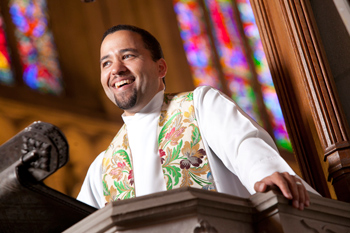


Editor’s note: Faith & Leadership offers sermons that shed light on issues of Christian leadership. This sermon on Martin Luther King Jr. was delivered on Sunday, Jan. 16, 2011, in Duke University Chapel.
So, once again this week, the American flag flies at half-staff, and whether we like it or not, a very old question about “the national character” has risen up for debate. Why does so much violence occur in our country, whence this anger, and what can we do about it? We have been schooled in our rights, but what are our responsibilities to one another? And who are we as a church, the community of Christians who live in North America? What vision of the kingdom do our words and lives proclaim?
Forty-three years ago, on the night before he was assassinated, Martin Luther King Jr. was wrestling with the same questions. He was making a speech in Memphis, Tenn., trying to explain how he had gotten embroiled in a local dispute involving sanitation workers. What did a Nobel Peace Prize winner have to do with striking garbagemen? His closest aides asked the same question and reminded him that he had more important things to do. Memphis was not a strategic city. The sanitation workers were not attractive victims like the children of Birmingham or the voters of Selma. As King spoke that night, a powerful storm moved through Memphis, and his speech was punctuated by claps of thunder, as if to say, “Listen, this is important!”
The historian Taylor Branch tells the back story. Local residents had objected to the sanitation workers’ practice of eating lunch and “picnicking” (as they called it) outside the trucks. And so the workers were instructed to eat in the truck -- but the cab of a truck will not accommodate a crew of four. One rainy afternoon, two of the workers crawled into the compactor on the back of the truck to eat their sandwiches. Something shorted in the electrical gear, the system engaged, and the two workers were compacted, like garbage. It’s no wonder that later, when their colleagues went on strike, many of them wore signs that read, “I am a man.”
And so that stormy night King asked the question, “Why Memphis?” He answered it by telling a story, the story of the Good Samaritan. A certain man was making a dangerous journey from Jerusalem to Jericho when he fell among thieves and was robbed, thrown in a ditch and left for dead. In his speech King declares that today in Memphis the man in the ditch is the sanitation worker. He tries to imagine why two religious professionals, the priest and Levite, didn’t stop to help. Perhaps, he says, it was because they were late for a meeting of the Jericho Improvement Association, or perhaps it was because they were more concerned with the law that forbids defilement, or perhaps it was because they were just plain afraid. You stop on a road like that, and you may well be the next victim. You open your home to the wrong people, and they will rob you blind. You stand up for the wrong cause, and your reputation may wind up in the ditch. In his speech, King says even honorable people ask, “What will happen to me if I stop?”
It’s a familiar question in our culture, the question of self-interest. Among politicians of both parties, it takes the form of the familiar mantra “the middle class.” If we provide benefits to the poor, in terms of health care, better education or other protections, what will be the effect on “the middle class?” Not, “What will happen to the poor if they are not cared for?” -- which is God’s question throughout the Old Testament -- but, “What will happen to us?” “You know who’s really suffering?” a fellow asked me at a fancy dinner. “It’s you and me, my friend. Say, can I top that off?” Likewise, the church asks, “If we focus our ministry on the needy, if we try to make a budget worthy of the Old Testament, what will happen to us as an institution?” The real question, King said in his last speech, is not, “What will happen to me if I do stop?” but, “What will happen to them if I do not?” Thus for King, Memphis did not represent a detour from a more important destination. It was his destination -- and his destiny.
King told this story a lot. I guess all preachers do. Sometimes, he told it with another point entirely. In another, more profound version of the story, the person in the ditch is not the sanitation worker, or the black man, or the poor woman, or the immigrant. America is in the ditch. It is America and the American church, as he often said, that has lost its way on a dangerous road. It has been stripped of its ideals and fundamental commitments and is in desperate need of rescue. It was America, he said, that had wasted so much of its resources on war that it had nothing left for the poor -- either white or black. He said it was America that had made absolute the distinctions between white and black, Jew and Gentile, and thereby created an environment of hate and division. And it was the American church, he said in his “Letter from Birmingham Jail,” that preached personal morality to the skies but on the larger moral issues of the day remained silent.
If America is in the ditch, who is this Samaritan? Jesus himself gives the answer, but it’s not the one we want. The Good Samaritan is the foreigner, the outsider, the “other.” The Good Samaritan is the last person you want to see when you’re in need of a helping hand. In his day, King identified the Good Samaritan with the black civil rights movement. By its willingness to suffer and work for change nonviolently, this movement would pull America (and the American church with it) out of the ditch.
In this telling of the story, the question is not, “Are you willing to stop and help?” but, “Are you ready to be rescued?” When Jesus first told the story, his hearers would have identified not with the helper but with the helpee, the man in the ditch. It’s the ordinary Jewish layperson on an ordinary little trip who winds up in the ditch. Thus Jesus is saying, “It’s somebody like you --why, it is you -- you are the man or the woman in the ditch. You are the church in the ditch, the nation in the ditch.” Are you willing to concede that the example of people unlike you may prove redemptive for you? From whom are you willing to accept help? From whom are you willing to learn?
At this point in our history, you could say we’ve tried a lot of salvations. We’ve tried unbridled expressions of rage, we’ve tried conspiratorial theories, we’ve tried rights without responsibilities, we’ve taken refuge in guns -- and we are not saved.
To whom shall we turn? Are there any other options out there? In his day, King made a controversial proposal. On the basis of Jesus’ life, ministry and death on a cross, he suggested that we try to love one another. It’s hard to imagine how the idea of love could be controversial, especially coming from a preacher. But he made it very controversial, because he took love out from under the canopy of the pulpit, where it’s the safe, expected word, and injected it into the realm of social conflict and public policy. He was forever speaking about love in all the “wrong” places: on highways, in pool halls, city halls, fire-bombed churches, even in Page Auditorium (in a university that for all practical purposes was still segregated). When he might have been talking about revenge or strategy, he spoke of reconciliation.
If you think love is only a smoochy feeling that comes with buttered popcorn, King’s use of the word will set your teeth on edge. If you believe love belongs only in private relationships, like romance or friendship, King’s use of it is unsettling. We’re tempted to say that love has no place in a violent world like ours, forgetting that the love of God in Jesus crashed into the political process and submitted to its rough justice. Jesus got himself crucified in a world like ours.
So if we find ourselves reaching up for a helping hand or a better idea this week, the “Samaritan option” is something to consider.
The story of the Good Samaritan is really two separate stories. Viewed from the road, it’s a story of encouragement to reach out to those who are lost and hurting, the way King did in Memphis, the way Jesus did throughout his ministry, the way we do in our better moments.
But this same story, when viewed from the ditch, where all of us have been at one time or another, takes on a different character. It asks an even more profound question: “Despite your own privileged education, your wealth, or your power -- do you understand how God might be using someone or something you never imagined to teach you and make you new?”
When God decided to redeem the human race, he sent someone we were not expecting. He sent a man named Jesus, whose teaching challenged the complacency of our religious categories and whose death was a sheer embarrassment. He was the one of whom Isaiah said, “He had no form or majesty that we should look at him, and no beauty that we should desire him. He was ... a man of sorrows, and acquainted with grief; and as one from whom men hide their faces” (Isaiah 53:2-3 ESV). The human race asks for help. God sends redemption in the form of a crucified Jew/Samaritan.
Is this a mercy you can accept? Is this a mercy you can live?
Yes, it’s a dangerous road, the winding road from Jerusalem to Jericho.
Just how dangerous? Forty-three years ago, it cost Martin Luther King his life.
How dangerous? You stop on it to help someone, and you may be its next victim.
Just how dangerous? It will disabuse you of everything you thought you knew about religion and politics, because on this road old enemies are transformed into new neighbors -- and then friends.
How dangerous? It will cause you to lift your arms for rescue to a crucified teller of tales.
Amen.