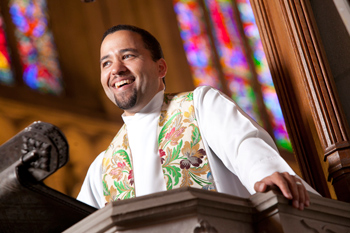


Editor’s note: Faith & Leadership offers sermons that shed light on issues of Christian leadership. This sermon was preached June 13, 2010, at the Service of Commissioning and Ordination for the UMC’s Holston Annual Conference.
Bishop Swanson has given me a generous gift by inviting me to share in this service. It was precisely 50 years ago, Annual Conference in 1960, that I was appointed at the naive age of 19 as the student pastor of Watauga Methodist Church in the Johnson City District. Forty-five years ago, I graduated from seminary, was received as a clergy member of Holston Conference, ordained an elder by Bishop H. Ellis Finger, and appointed to Elizabeth Chapel. So sharing in this service has particular poignancy and meaning for me. It has been and continues to be an exciting journey with unexpected victories and haunting failures.
But such is the reality of Christian ministry. Being claimed and called by God is both fulfilling and dangerous. It includes mountain peaks of joy and valleys of disappointment, profound experiences of divine presence and prolonged dark nights of the soul, times of great adventure and confidence and periods of bewilderment and uncertainty. Just ask Abraham and Sarah, Moses and Miriam, David and Deborah, Mary and Joseph, Martin Luther King and Mother Teresa. Living one’s baptismal identity and sharing in God’s mission is fraught with treacherous temptations and profound triumphs. Ask Jesus!
In chapters 3 and 4, Luke describes Jesus’ transition from the private life as a carpenter to a public ministry as an itinerant preacher, teacher, prophet and healer. The drama of his public commissioning is in three acts -- baptism, temptation and hometown sermon at Nazareth. In these three scenes are exposed the ambiguities and assurances, the temptations and triumphs of those claimed and called by God. Here is revealed in dramatic images the source and shape of Christian ministry. Let us move into these stories as we examine and affirm God’s claim and call on these persons who are to be commissioned and ordained, and as we all continue to be claimed and called by God.
It all begins with baptism
Luke begins Jesus’ public ministry with his baptism (Luke 3:21-22). John the Baptist is announcing to the crowds that the time of God’s kingdom is dawning in their midst. One who is the very presence of God’s new world is coming! As preparation for his coming, John invites the people to enter the waters of the Jordan, that crossover river between bondage and wilderness wanderings and God’s promised land. Joining the crowd entering those cleansing waters of freedom and promise was Jesus. Luke makes no fuss about his distinction from the crowds; he simply says, “When all the people were baptized, and when Jesus also had been baptized and was praying,” as he came up from the water, “the heaven was opened, and the Holy Spirit descended upon him in bodily form like a dove. And a voice came from heaven, ‘You are my Son, the Beloved; with you I am well pleased.’” [NRSV]
The first act in Jesus’ transition into public ministry is baptism, in which his identity as God’s beloved Son and God’s faithful servant was clearly affirmed. Luke knew that the divine message at Jesus’ baptism combined the words from the coronation Psalm 2:7, “You are my son; today I have begotten you,” and the image of God’s servant in Isaiah 42:1, “Here is my servant, whom I uphold, my chosen, in whom my soul delights.”
Baptism is the outward and visible sign of God’s action in claiming us as beloved sons and daughters, those who bear the divine image and are incorporated into Christ’s body, his death and resurrection, and called to share in God’s mission of the redemption of the whole creation. Baptism defines who we are, who our family is and what our ministry entails. This identity is accompanied and affirmed by the Holy Spirit, which persistently woos us, guides us and reminds us that we have been claimed as beloved children of God, redeemed in Jesus Christ, and called to participate in God’s present and coming reign in Jesus Christ.
Our primary calling, then, is to accept and live our baptismal identity! That is a ministry we share as laity and clergy. Ordination does not supersede baptism. Rather, it derives from baptism. And the bedrock calling of the ordained and commissioned is to support the baptized in living their identity in the world. There is no higher calling than our baptismal calling. Baptism has to do with our being as beloved daughters and sons of God: it is who we are.
The glorious, triumphant news is that it is all a gift. We cannot earn our worth and relationship as God’s son or daughter any more than we earned our right to be born. Baptism is God’s affirmation, “Do not fear, for I have redeemed you; I have called you by name, you are mine” (Isaiah 43:1). Therefore, our worth lies in the One to whom we belong, and nothing can take that from us, not even death itself! And the glorious good news is that it is all a gift. We call it grace. Our basic identity and worth are not the triumph of our efforts. They are the free gift of God. In the words of the Epistle of First John: “See what love the Father has given us, that we should be called children of God; and that is what we are. ... Beloved, we are God’s children now; what we will be has not yet been revealed. What we do know is this: when he is revealed, we will be like him, for we will see him as he is” (3:1-2).
That is the source of our morale, not the size of our churches or our titles or ecclesial positions. Martin Luther reports that when he became discouraged and depressed by conflicts within and without, he would say, “But I have been baptized.” The tempter would say, “Luther, you’re a hopeless, stubborn, prideful, ignorant, arrogant, no-good sinner,” to which Luther would reply, “True enough, devil, but I have been baptized.”
Being sons and daughters of God and living our baptismal identity as God’s servants, however, leads us into all kinds of subtle temptations. Those temptations are what Parker Palmer calls “the shadows of leadership.” Every exalted position -- and being the child of the King is an exalted position -- has its shadows or temptations. Follow Jesus into the wilderness and see.
Temptations
Still wet from the waters of baptism, Jesus is led by the Spirit into the wilderness, where his identity and mission are tested and forged. The tempter’s first words assault Jesus’ identity and the shape of his ministry.
“If you are the Son of God, command this stone to become a loaf of bread,” and later, from the pinnacle of the holy Jerusalem temple, “If you are the Son of God, throw yourself down from here.” Can’t you hear the cynicism in the tempter’s seduction: “If you are the Son of God, prove it by satisfying the hungers and desires of the people and winning their applause with your spectacular feats”?
However you envision the tempter, whether as a personal being or an inner struggle or as systems of domination that enslave us, we all know too well that there are forces and influences that seduce us away from our true identity and purpose as beloved children of God, and that distort the divine image.
The relentless temptation is to doubt our identity and to attempt to prove our worth. Our identity and worth are gifts bestowed upon us, not earned achievements. Palmer identifies insecurity as a shadow of leadership. Insecurity, inferiority, feelings of inadequacy dog us all, especially we Americans who prize individualism, personal initiative, pulling ourselves up by our own bootstraps. We aren’t very good at accepting gifts, especially the gift of our very identity. Surely there is something I can do to secure myself, redeem myself, save myself, prove myself. We are much better at preaching grace than we are living it.
Ordained and commissioned ministry is especially susceptible to trying to prove and earn our worth. One means is by what one of my faculty colleagues at Duke calls “being a quivering mass of availability” -- meeting people’s expectations and superficial desires rather than identifying the hungers that cannot be satisfied with bread. Or using the pastoral role to ingratiate ourselves to the masses so they will applaud us, validate our importance, and fill our need for praise and affirmation. The consequences can be catastrophic boundary violations and traumatic abuse of the pastoral relationship; and [this shadow] is often manifested in using congregations as steppingstones in career advancement, which is fleecing the sheep rather than shepherding them. A prayer that I have prayed almost every day of my 50 years of ministry is “Oh God, do not let me be unduly distracted today by either criticism or praise.”
The ministry offers numerous substitutes for baptism as our identity and ministry -- size of church, titles, ecclesial positions. We are part of a culture that values worth on the basis of what we know, how we look, what we own, what we produce. Our appointments, salaries, attendance, budgets, ranking on the “work sheet,” political clout and awards become our identity. What we do replaces who we are; being is replaced with doing. Such proofs of our identity are like trying to fill our deep hunger to be somebody with bread made from stone.
Another deadly temptation is the abuse of power inherent in being called by God, confusing political and institutional power with love. Or, rather than being formed by the power of love, we are shaped by the love of power. The tempter showed Jesus the kingdoms of this world and said, “If you ... will worship me, it will all be yours.”
Henri Nouwen reminds us that “one of the greatest ironies of the history of Christianity is that its leaders constantly gave in to the temptation of power -- political power, military power, economic power, or moral and spiritual power.” He adds that “power offers an easy substitute for the hard task of love. It seems easier to be God than to love God, easier to control people than to love people, easier to own life than to love life.”
Palmer identifies “functional atheism” as [another] of the shadows of leadership. It is the notion that everything depends on me. Security is sought through controlling others. Success is defined in terms of mastery of others and circumstances, the pyramid image with the greatest at the top. Upward mobility and ever-widening spheres of influence and dominance are the goals.
But proving our identity and worth, attaining positions of power, popularity and applause -- these are not triumphs, but rather temptations. Follow Jesus out of the wilderness into his hometown of Nazareth and we see his image of triumph, what a Spirit-formed ministry derived from being claimed and called by God looks like.
Triumphant ministry
Jesus’ alternative to the tempter’s vision of triumphant ministry is made explicit in his hometown of Nazareth. With a laser focus sharpened by the wilderness struggle, Jesus enters the synagogue. Of all the Scriptures available in the Torah, the Psalms and Wisdom, Jesus responds to the tempter’s agenda with an image from the prophetic Jubilee tradition. Turning to Isaiah 61, he reads: “The Spirit of the Lord is upon me, because he has anointed me to bring good news to the poor. He has sent me to proclaim release to the captives and recovery of sight to the blind, to let the oppressed go free, to proclaim the year of the Lord’s favor” (Luke 4:18-19).
While the tempter kept the focus on the opportunities to prove his identity, enhance his position and power, Jesus pointed beyond himself to God’s mission. Here Matthew and Mark put his mission in somewhat different words, but with the same focus. In those Gospels, Jesus announces his mission in these words: “The time is fulfilled, and the kingdom of God is at hand; repent and believe in the good news” (Mark 1:15).
The focus shifts from our identity and call to God’s agenda, which is coming to fulfillment in Jesus the Christ. Ministry isn’t about us; it is about what God is doing! And God is bringing a whole new order of things. God is bringing a new world -- a world in which all persons know and are treated as beloved sons and daughters of God, a world in which all barriers are removed and the human family is one, a world in which the least and most vulnerable have all they need to be fully who they are as God’s beloved, a world in which all creation is healed. Serving that mission is what ministry is all about: it is forever pointing to God’s reign of compassion, justice, generosity and hope.
Jesus is the very incarnation of triumphant ministry. He was born among the homeless in a stable, spent the first two years of his life as an immigrant, grew up in a working-class family, lived among the poor, associated with outcasts and sinners, loved and healed and forgave and welcomed the nobodies and the despised, was convicted and labeled and executed as a criminal, [was] buried in a borrowed tomb, was raised from the dead!
While the tempter attempted to seduce Jesus to a life of upward mobility, Jesus chose a life of “downward mobility” and being exalted by God. Faithful ministry is entering in solidarity with the poor, the imprisoned, the blind, the oppressed, the immigrants, and announcing the coming of God’s jubilee, God’s reign. It means being as familiar with the inside of the local jails and prisons as the inside of the local hospitals and retirement homes. It involves including on our visitation lists those who live in the mobile home parks and government housing and the homeless shelters, as well as the gated subdivisions and corporate boardrooms. It includes reminding people that justice is part of God’s agenda, that God’s kingdom knows no national boundaries -- God’s love encompasses those we label as enemy.
Christian ministry means living now in the light of the ultimate triumph of Christ’s reign. Christ has already taken on all the seductions and principalities and powers that threaten God’s mission. And the good news is this: God in Christ won the battle! The decisive victory has already been won. We, therefore, can confront our temptations in the light of Christ’s victory in the wilderness and his ultimate triumph on the cross, for we know that the future belongs to the One who has claimed us as beloved sons and daughters and called us to share in God’s mission that is nothing less than the salvation of the entire creation.
You who are being commissioned and ordained: Remember your baptism. You are claimed as God’s beloved son, God’s beloved daughter; and you are called to share in God’s mission of the reconciliation and transformation of the world. Before you looms the wilderness and a world filled with powerful and seductive temptations. Move toward the future with courage and hope. The One who claims and calls you has triumphed through the wilderness and has overcome the world. Hear his promise: “Lo, I am with you always, to the close of the age” (Matthew 28:20 RSV)!