
Editor’s note: Faith & Leadership offers sermons that shed light on issues of Christian leadership. The Rev. Samuel Wells preached this sermon on Sept. 4, 2011, at Duke University Chapel.
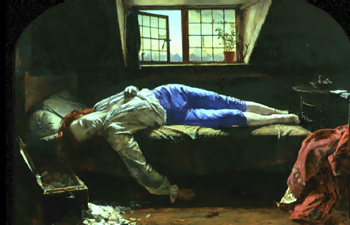
The Pre-Raphaelite painting “The Death of Chatterton” is an archetypal image of what it means to be an artist. Thomas Chatterton, a poet and native of my hometown, Bristol, England, dies in London in 1770 aged 17, penniless, desperate and alone. His clothes are bohemian and raffish; his art has been seldom understood, and scarcely ever appreciated. His talent is enormous, and in this tiny garret apartment he has clearly had spurts of breathtaking and rapid creativity. Yet the scraps of torn paper at this side demonstrate his tortured struggle.
We vividly see the contrast between the intensity of his life’s purpose and the terrible waste brought about by his poverty and lack of critical acclaim. The painting is telling us that to be an artist is to be possessed, impassioned, alone, tragic and tortured -- but nonetheless glorious and beautiful.
Why then would anyone want to be an artist? What got it into the minds of the leaders of Duke University to make transforming the arts the fifth of its six strategic goals?
The answer is that art is not simply tortured and lonely and tragic. Art is the threshold you cross as soon as you move from the indicative of what things are to the subjunctive of what things could be, from grabbing something in one hand to use it to cherishing something in two hands truly to enjoy it, from regarding an abundance of meanings as exasperating and distracting to seeing a plurality of possibility and interpretation as joyful and life-giving.
Art is not so much the production of distinguished artifacts or even the experience of profound creativity. Art is what happens within a triangle of forms, media and ideas. For example, the form might be a landscape, the medium might be a watercolor, and the idea might be the healing goodness of living things.
Within the triangle of form, medium and idea lies a myriad of possibilities, and art refers not just to acts of creation but also to moments of appreciation and interpretation and revised understanding.
Artists are those who live their lives within that triangle of forms, media and ideas, refining their skills, understanding their tradition, enjoying the interplay of genres, and finding new ways to configure and present them. A true artist is not so much one who dies a tragic, tortured, histrionic death as one who embodies the disciplines of their craft so as to make it a way of life -- and whose art evokes imaginative constructions, fertile conversations and engaged responses in the lives of its audience. These are all the reasons that art, in its many forms, belongs at the heart of a university.
But what does the Christian faith have to bring to this world of art? How does an undergraduate or graduate student, drawn into this triangle of form, medium and idea, come to understand a calling to be a visual, literary or performance artist, and continue to see that calling within their Christian vocation as a whole?
Five centuries ago, the theologian John Calvin described the ministry of Christ as a threefold office. Calvin looked at the three roles for which persons were anointed in Old Testament times. The roles were those of prophet, priest and king. Calvin described how Jesus exercised all three of these offices, as prophet (especially in his life), as priest (especially in his death) and as king (especially in his resurrection).
I’d like to explore with you today what it might mean for an artist to exercise these three roles -- or, perhaps more collectively, for the arts in general to carry this threefold purpose in our society, and particularly at this university.
The role as prophet
Many artists today can readily identify with the role of the prophet.
What a prophet does is to hold a mirror up to society or an individual and ask, “Are you proud of what you see?” A prophet recalls the founding commitments of a person or a body of people and asks, “Have those commitments been honored?” A prophet casts a dream of what it might mean for people or societies to fulfill their true potential and says, “Look, here is the painful gap between ideal and reality.”
Artists are drawn to all of these roles.
A prophet says, “Let’s see what this looks like upside-down.” “I wonder how life would be if all the light shone from the back.” “Let’s imagine we hear this baritone several times, but each time it becomes more threatening or more mysterious.” Prophets challenge, reconfigure, expose, highlight, ridicule and shock. That’s what artists do.
Sometimes, when an artist’s idea sticks outside the triangle and leaves the form and medium behind, or when the medium is so distressing it obscures the form and idea almost altogether, art becomes notorious for upset and scandal.
The offended people who crowd in to condemn the artist -- or art in general -- at such a moment have often forgotten, or never appreciated, that artists are prophets. Prophets often shock people, too. Jesus shocked people with his prophetic actions of cleansing the temple and healing on the Sabbath.
Not all offensive actions are prophetic, but some prophetic actions are offensive, and just because an artifact offends some people, that doesn’t inherently mean it’s not art. It just means it’s testing the boundaries of idea or medium.
Three years ago, this chapel staged a performance of Benjamin Britten’s “War Requiem.” Britten was a pacifist, and he weaves the bitter and ironic poetry of Wilfred Owen with the traditional words of the Latin Mass. Britten’s composition is a prophetic work of art. It shocks some, transforms many and moves almost everyone. It asks two questions: “How can we live with the Christian faith after all this horror?” and “How can we live without it?” That’s what prophets do.
The role as priest
The second role of the artist is to be a priest.
The poet George Herbert says, “A man that looks on glass, / On it may stay his eye; / Or if he pleaseth, through it pass, / And then the heaven espy.” But just imagine if that glass is stained glass -- just imagine if that glass is the music of Bach or the painting of Giotto or the poetry of Shakespeare.
For the artist, every work of art is an icon, through which the observer can look and see ultimate truth, profound wisdom, the heart of God. The artist strives to approximate that epitome of all things and hopes that the audience will, at least in its imagination, transcend whatever limitations there are in the work or performance or presentation and see beyond even what the artist can see, see beyond the horizon, beyond the stars.
In a general way, this is what Christians mean by the notion of a sacrament. In a sacrament, a priest takes the ordinary stuff of life -- bread or water -- and makes it speak of heaven.
A sacrament lies at the intersection of actions and words, where the presence of God is felt or tasted or touched in the faithfulness of what takes place and the way it imitates the pattern and character of God.
An artist takes the ordinary stuff of earth -- wood or metal or canvas -- and makes it speak or sing of the divine. It’s a priestly role.
When you listen to the trailers for a classical radio station, you’d be forgiven for thinking that classical composers throughout the centuries have really been in the therapy business, and that Mozart, Beethoven and the rest devoted their lives to making background accompaniments to bubble baths and foot massages. But this simply reflects the way our society has transformed priests into therapists and therapists into priests.
The point is that Mozart and Beethoven roll back the gates of heaven and bring us face to face with God. And that’s a priestly role.
When you stop believing in God, you still know you want what Mozart and Beethoven give you, but you don’t want to call it God, so you call it soothing or searing -- but that’s just because you don’t trust the word “holy.”
Artists are high priests of creation: they gather around them all the fruits of creation, just as a priest does around an altar, and orders those gifts in such a way as to show the divine in the human and earthly. That’s what priests do.
The role as king
And then there’s the artist as king. By king I don’t mean being in charge. I mean showing what humanity can do when it fulfills its potential.
The architecture of Duke Chapel is kingly art -- full of majesty and splendor. The brass of today’s music is inclined toward the kingly dimension of art -- especially when on Easter Day it explodes with joy over the wonder of Christ’s resurrection.
Kingly art is art that thrills and delights and excites and enthralls -- art that stretches our imaginations to their limit in exaltation and awe and delirious rejoicing.
I want to tell you about one of my most treasured encounters with kingly art.
Twenty years ago, when I first started out as a priest in the Church of England, I lived in a town that was both large enough and small enough to have its own road sweeper. When the truck had gone down every street spraying and blowing and sweeping, the road sweeper followed with his cart full of brushes and buckets and hoses. I would pass the gruff and heavyset road sweeper many days of the week as I walked around the town doing home visits, and we would exchange respectful monosyllables of mutual acknowledgment.
One day I got a call that an elderly woman in the parish had died. I headed to her home, where I was told her son would greet me. Her son, who did indeed greet me, turned out to be the road sweeper.
He sat me down and wept as he mourned his mother, and we planned the funeral together. “What keeps you going?” I dared to ask, as I viewed his bare apartment, now even emptier without the presence of his elderly mother. “These,” he said, sweeping his hand across a swath of videotapes covering the wall from floor to ceiling.
I thought it might be “Great Boxing Matches of the 1980s,” or maybe “Classic Truck and Trailer Escapades of All Time.” But I was wrong. “Op-ra,” he said, with a tear in his eye.
I suddenly thought, “You mean Oprah,” and I pondered how a talk-show hostess from Mississippi could cross the Atlantic with such ease and stir the heart and soul of a road sweeper. Maybe, I speculated, he and his mother had watched Oprah’s shows together.
“Op-ra,” he said again, with his throaty voice. “This is my glory.”
And I looked closely, and opera it was. Verdi, Puccini, Mozart, Rossini, Bellini, Strauss, Wagner, Stravinsky -- “The Magic Flute,” the “Ring” cycle, “La Traviata” -- every opera you’ve ever heard of was on those shelves.
“This is my glory,” he said, with tears falling down his cheeks.
Here was a man who spent his life in the gutter and had just lost maybe the only person that had ever loved him -- and he was showing me where to find beauty. I heard a voice in me saying, “Dust we are, but we are dust that dreams.” That’s the kingly power of art.
The great artist
Psalm 150 is a resounding celebration of the kingly dimension of art. It is a call to pull out all the organ stops and, as the conductors like to say in rehearsal, play it once more, with feeling.
There’s also a subtle prophetic message there, because there’s nothing elitist about this psalm. On the contrary, it is determinedly inclusive.
It’s a psalm about what art is like in heaven -- what the psalm calls God’s “mighty firmament.” In heaven, the music is joined by men, who in ancient Israelite culture traditionally would play trumpet, lute, harp and cymbals, and also by women, who traditionally would join with dance and tambourine. In the final line, everything that has breath -- every single creature on earth -- joins the heavenly chorus.
Here is a prophetic statement that art may be the realm of genius but also has its democratic moments. Perhaps more even than the kingly and prophetic dimensions, Psalm 150 is profoundly priestly, because it’s fundamentally a call to worship.
The whole psalm is about the wonder of God and the infectious character of celebrating God’s glory. The word “praise” occurs 13 times in six verses. Every instrument, every person and, in the end, every living thing on earth discovers its ultimate purpose in glorifying and enjoying God forever.
This is the crescendo that brings the hymnbook of Israel and the church to a rousing conclusion. And that’s the discovery that lies at the heart of a Christian notion of art and of what it means to Christians that a university like Duke has decided art is going to be at the center of its identity.
Art is finally about glory. Artists fundamentally construct acts of worship.
They may be so prophetic that their bitterness and irony are more about lament than praise -- but lament is still a form of worship. They may be so ordered and bumptious that it seems to be more about cleverness or vainglory than genuine exultation -- but vainglory is merely a distorted form of worship.
The artist strains for what cannot be said, cannot be expressed, cannot be contained in conventional forms. It cannot be contained because it’s from God, and God cannot be contained or fathomed or comprehended.
That’s why art is exhausting, compelling and ultimately fundamental to human existence. Art is where we imitate the nature of God -- in the excess of energy that created the universe, the exquisite miniature that constituted the incarnation, the harrowing agony that underwent the cross, the restorative joy that burst out in the resurrection, and the dance of delight that caught fire at Pentecost. Because God is the great artist, and each human life is an event of recognition, interpretation and improvisation on the wondrous imagination of God.
Are you an artist? According to Psalm 150, you are. Is there a yearning in you to express the depths, the ache, the fury, the glory? Are you a prophet, seeking truth and a closer social embodiment of it? Are you a priest, rolling back the veil between heaven and earth? Are you a king, rousing all creation to its potential and praise? Are you allowing the Holy Spirit to make you a work of art that turns all creation into alleluia?