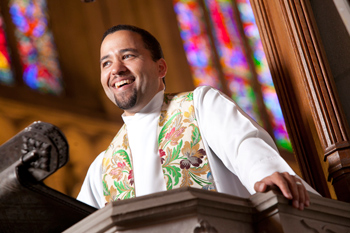


Editor’s note: Faith & Leadership offers sermons that shed light on issues of Christian leadership. This sermon originally was preached at Duke University Chapel on April 22, 2012.
Have you ever sat still in the early morning and heard the dawn chorus? Have you ever felt your heart rise in a throbbing ovation as the birds of the air form an orchestra of glory and voice creation’s praise?
Fifty years ago, the conservationist Rachel Carson published a book entitled “Silent Spring.” Carson pointed out the way pesticides were coming to dominate American agriculture and were damaging not only birds and animals but also humans. Just imagine, she said, a spring in which no birds sang: it would be a silent spring.
And if that spring lies in the not-too-distant future for the birds, how long before humanity meets the same fate? First, there will be a silent spring; eventually, there will be no spring at all.
Those who marked the first Earth Day on April 22, 1970, credited the publication of “Silent Spring” with the beginnings of the modern environmental movement. And Carson’s book marks a suitable emblem for ecological concerns, because it synthesizes the four dimensions that have characterized the movement ever since.
The first is the urgent sense of human catastrophe. Ecological concerns, such as those raised by Rachel Carson, have a wide following, but what makes them a focus of universal anxiety is the claim that they threaten to diminish human flourishing in the immediate term and terminate human existence in the medium to long term.
“We’re all doomed.” That kind of threat makes the ecological movement unique in its claim on the public imagination. It’s a slow-burning version of the threat of nuclear annihilation that mesmerized people’s vision at the height of the Cold War.
The second dimension is the profound sense of grief that these environmental threats all have a human cause. This isn’t a crisis that’s coming from the outside. This is a crisis humans are bringing on themselves.
I recall a conversation with an activist friend who was estranged from the church. I asked her what she so disliked about Christianity, and she said the biggest thing was that the clergy were always talking about sin, and it all seemed so negative and bitter and judgmental and life-destroying.
I then asked her why she was so passionate about ecology, and without a second thought she launched into a tirade about how people were damaging the air, the Earth and the seas, and she wanted to spend her life changing their hearts and minds and reversing the damage they’d done.
I said to her, “Who’s the one talking about sin now? You sound more evangelical about the environment than most clergy are about Jesus.”
The ecological movement may use different language, but it’s generally a lament for human participation in destroying habitats for other creatures and ourselves, and a call to repentance and a new way of living. The Earth is like an oppressed and enslaved people, and ecologists are shaking their finger like Moses, saying to Pharaoh, “Let my people go.” For many environmentalists, the question of human survival is just the tip of the iceberg: what’s at stake is an economic, social, ideological and sometimes religious transformation.
The third dimension that’s found in Carson’s book and among the great majority of environmentalist campaigners is a sincere optimism that the ecological crisis is something that can be significantly addressed through public policy initiatives -- through legislative change, regulation and prescription.
“Silent Spring” is a great motivator for activists, because the uproar caused by the book led John F. Kennedy to set up a commission to investigate its claims, which in 1972 led to the banning of the insecticide DDT in America, a ban extended globally 30 years later.
In 1972, the first United Nations Conference on the Human Environment was held in Stockholm, Sweden, and the public forum on the fate of the Earth convened in earnest. Henceforward, the great debate in environmental circles has been between idealists who want to promote a different way of life that’s not based on a predatory relationship with the Earth, sky and seas and the pragmatists who want to focus the movement on achievable legislative regulation.
The Earth is like the Titanic propelling itself toward the iceberg, and the Earth’s richest nations are like the Titanic’s owners, saying, “Faster! Faster!” Of course, the problem with the Titanic was not that it didn’t have a rudder but that the captain didn’t use it. In just the same way, say the activists, it’s not too late for the Earth to change course, once people accept how catastrophic our present navigation is.
But “Silent Spring” also represents a fourth dimension. It imagines a spring with no birdsong: no chirruping, tweeting or crowing. In other words, it imagines the Earth without a soul. This is a different kind of concern.
Its question is less about the preservation of the planet and its inhabitants, including us, and more about the qualities that can’t be measured or assessed. How do you quantify the value of a bird’s song? How do you estimate the impoverishment of a sky without the waft of beating wings? Even if the planet can survive humanity’s prodigal path of self-destruction, will something precious, and beautiful, and irreplaceable, be lost?
These are the four dimensions of the ecological crisis as it has emerged in the last 50 years. These are the four concerns that surface on the public’s consciousness, if not every moment of every day, at least on April 22 each year, when we stop to mark Earth Day.
But how do Christians understand these questions?
It’s important to acknowledge how politicized these issues have become. There’s nothing controversial about wanting to save humanity from destruction, although there’s inevitable skepticism that the shepherd may be crying wolf; and that skepticism understandably comes most acutely from those whose economic livelihoods are at stake. And there’s nothing controversial about wanting to preserve the birds and their song. But once you start pointing the finger of blame and invoking legislative regulation, then you’re in the middle of politics at its most agitated and partisan.
Why is the ecological crisis a problem for Christians? Some would say it isn’t a problem for Christians. Here there’s a good argument and a bad argument.
The good argument is that God is God. If God has our destiny in hand, then a mere setback like the depredation of the Earth isn’t an insuperable problem. Surely, if we were to ruin the Earth, God could just reach into a divine storehouse and bring out another Earth that just happened to be lying around for such an eventuality -- or even make one specially.
This is a good argument, because it puts things in perspective. It’s true that human sin can never be sufficient to divert the ultimate will and purpose of God. Our sin is never so bad that it can overshadow God’s grace.
We can destroy the planet, just as we can destroy our lives and the lives of others; but we can’t destroy what God will finally make of our lives or the life of the planet. In lamenting the condition of the Earth, let’s not make humanity too big by exaggerating our ability to ruin everything or make God too small by forgetting that this is always a story about God that we get to play a part in, not the other way round. Christian concern for the environment can’t be about self-preservation. It must be based on something else.
Here’s the bad argument: If you say Christians hope to be with God forever, and if you say that that life is the union of our soul with the eternal Trinity, then the rest of planet Earth, besides human beings, is one of three things.
It could be an instrument that can bring us closer to God, through experiences of intimacy, wonder or joy, and thus like a ladder we can kick away when it’s got us to the place we need to be. It could be a luxury, like a set of clothes, that makes our earthly life more congenial but isn’t fundamentally necessary. Or it could be a limitation that imprisons us, through entanglement, distraction or ensnarement, like a straitjacket, that threatens to keep us from our heavenly home.
If the created order is a ladder, a luxury or a limitation, then the environmental crisis isn’t a major problem, because the Earth isn’t something we fundamentally need and depend upon.
This is where the Christian view of the Earth has so often gone so wrong. Where do we start if we’re going to put things right? We start where all Christian theology starts -- with the resurrection of Jesus Christ.
Let’s look at today’s Gospel reading from Luke chapter 24. Why does the resurrected Jesus appear on Earth at all? If our resurrected destiny is in heaven, why doesn’t Jesus go straight there? Well, see what we learn from Jesus’ brief appearance to the disciples on the evening of the first Easter Day.
Jesus still has the nail marks on his hands and feet . That means his resurrected body is the same as his earthly body. Jesus is not a ghost. That means his resurrected body really is a body, and not a disembodied soul. Jesus eats broiled fish. That means the created order still has a vital part to play in his heavenly existence.
These three revelations completely overturn the suggestion that the environmental crisis is not a problem for Christians. If the resurrected Jesus is a real body, a body in the image of his earthly body, a body that interacts with the environment not just externally, by moving about, but internally, by eating fish, then the Earth cannot be just a ladder, a luxury or a limitation. It must be integral to our identity and our relationship with God.
These were the kinds of insights that led the early church to realize the full extent of what God did in the resurrection of Jesus. Resurrection doesn’t mean our souls escape the prison of the world, pausing only for harp lessons and the fitting of angelic wings before flying away to cloudy bliss with God.
Resurrection means the promise that Earth will come to heaven and heaven will come to Earth. That’s what happened at Christmas, in the appearance of the fully human, fully divine Jesus. And that’s what will happen on the last day: the marriage of heaven and Earth. Every way in which Earth is too flawed, finite or sinful to be embraced by heaven has been removed by Christ’s resurrection. Earth isn’t a ladder, a luxury or a limitation -- it’s the theater of God’s glory, the playground of God’s delight, the garden of God’s encounter with us.
So the reason Christians care about the environment is not because if we don’t, we’re toast.
The reason is that if we’re not interested in the home God has made to dwell in with us now, how can we claim to be eager for the home God has made to dwell in with us forever? By the way we enjoy the playground God has given us to enjoy today, we show God how deeply we long to dance with the Trinity in eternity. If we don’t treasure the earthly theater of glory God has given us, God can only assume we’re not interested in entering the heavenly one. Cherishing creation is the way we show God our gratitude, the way we humbly acknowledge our creatureliness, and an important way in which we worship.
Polluting Earth, sky and seas, depleting habitats, overfarming land and ocean, eradicating species -- such practices tell the rest of creation it’s disposable, tell the rest of humanity that its survival is secondary to our comfort, and tell God that we’re bent on obscuring eternal grace with temporal consumption.
This is sin, in its simplest definition: being so shortsighted that we willfully shut ourselves out of God’s abundance and imprison ourselves in our own scarcity. And we’re all a part of it, however often we visit the farmers’ market, however many times we sign an email with a pious message about saving paper, however frequently we sprinkle our conversation with words like “sustainability” and “ecojustice.”
For Christians, the environmental crisis may be a problem. But it’s certainly an opportunity. It’s an opportunity because Earth Day is perhaps the greatest-ever parable of the Christian story. Earth Day celebrates the wonder of creation, in its abundance and diversity. It recalls the day the birds began to sing. Earth Day calls us to repentance when we remember the Fall, the human destruction of God’s precious gift.
It portrays the day the birds fell silent and forgot how the song was supposed to go. But Earth Day does more than that. It reminds us that there was a bird that came to Earth and taught us the tune we’d forgotten, making our hearts sing again. And that there will come a day when all creation sings; not just the birds but the rocks and stones and oceans and mountains themselves will cry, “Alleluia.”
And in the meantime, we remember this story by the way we sing and seek to turn our lives and our world into a song. We remember this story by the way we inspire others to sing with us and find in themselves a voice they never knew they had. We remember this story by singing this song back to those who’ve forgotten it until they remember how it goes.
That’s what Christians do in the face of the ecological crisis. That’s what Christians do on Earth Day. That’s the way Christians turn Earth Day into what it was always destined to be. Heaven day.