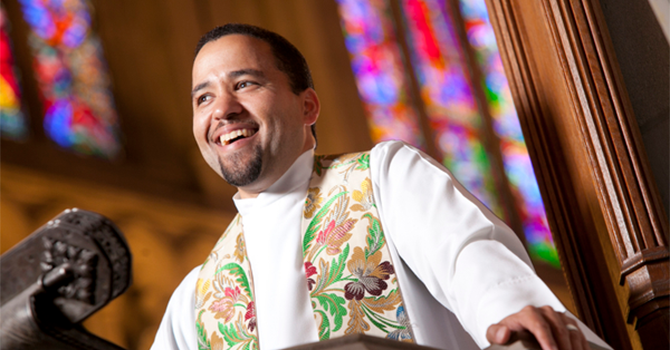

Editor’s note: Faith & Leadership offers sermons that shed light on issues of Christian leadership. The following is a sermon preached by the Rev. Richard Hays for the ordination of his son, the Rev. Christopher Hays, at La Crescenta Presbyterian Church, La Crescenta, Calif., on March 8, 2009.
Genesis 32:9-11, 22-30; Colossians. 1:9-14; Revelation 4:10-5:10
I have to admit, I didn’t always see this coming. But having watched Chris grow up, I realize now that I probably should have anticipated this day, because there is a pattern here.
When Chris was five years old, there was that classic pennant race between the Boston Red Sox and the New York Yankees, the one that ended in a one-game playoff won by the Yankees on Bucky Dent’s home run. Chris watched his longsuffering dad desperately rooting for his beloved Red Sox -- and he decided to become a Yankees fan.
Later, when Chris began to feel the inexorable pull of vocation to the serious academic study of theology, he sized up his father’s career as a New Testament scholar -- and decided to assert his intellectual independence by going into the field of Old Testament studies.
And so, when the time came that Chris felt God’s powerful call to ordained ministry, it was probably inevitable that he would take note of his dad’s service as a United Methodist minister and once again rebel against the paternal example -- by being ordained in the PC(USA). And so we find ourselves here this evening…to celebrate this latest contrarian act of rebellion.
To be fair, I should acknowledge that Chris comes by his Calvinist inclinations with an honest sense of family roots. His proud mother was a cradle Presbyterian and indeed served as an elder in the First Presbyterian Church of New Haven during Chris’s formative adolescent years. And even his Methodist father harbors the secret opinion that Calvin and Barth got a lot of things right.
The truth is, of course, that all of us are here to celebrate this glad occasion with great joy, along with the due sense of awe that always attends any service of ordination to the ministry of word and sacrament in the church of Jesus Christ. We are here to solemnize the particular call that lies on Chris’s life and to confirm publicly the office he now assumes within the church. But at the same time, we are mindful that ministry is first and last the work of the Holy Spirit in the church, and that all of us, as the people of God, are called in one way or another to share in the work of ministry through the diverse gifts and graces which the Spirit distributes broadly among us all. And so, as we reflect together on the Scriptural texts and on the prayers and liturgical actions through which we set Chris apart for this work, each of us here should also prayerfully consider our own calling and renew our own sense of vocation, whatever it may be, within the church’s ministry.
But as we enter that process of prayerful consideration, we have to acknowledge that the Scriptural texts Chris has chosen for this occasion are more than a little daunting. Interestingly, none of them says anything at all about ordination or about ministry as such. The letter to the Colossians is addressed to all “the saints and faithful brothers and sisters in Christ in Colossae,” (Colossians 1:2) and it speaks to all of them, together, as people who have been “rescued . . . from the power of darkness and transferred . . . into the kingdom of his beloved Son.” (Colossians 1:13) And we get the distinct impression from our other two texts that being transferred into that kingdom is both a cause for joy and -- at the same time -- a strange and fearsome experience, as love always is. I want to reflect with you tonight about these two strange texts from the beginning and end of the canon, from Genesis and Revelation. What do they have to teach us about ministry?
We begin with Jacob. From the day of his birth, he was a trickster and an operator, grabbing and scrambling, figuring the angles to outsmart and outmaneuver his brother Esau -- indeed, cutting a deal to swindle him out of his rightful inheritance -- then later jockeying for economic advantage with his equally devious father-in-law, Laban. You can bet that if the banking business had existed in his day (it was actually forbidden by Old Testament law -- but that’s a topic for another day), Jacob would have been packaging derivatives and collecting sweet executive bonuses. But -- as is always the case -- the day of reckoning was coming. After long absence, Jacob is returning home, preparing to face his estranged brother Esau, whom he had defrauded. And it is under these circumstances that he meets God.
God does not come to him as some sweet, forgiving presence. Rather, under the cloak of darkness, God comes as a mysterious adversary, appearing from nowhere to accost Jacob in a wrestling match. The struggle is lengthy and inconclusive, but Jacob hangs on for dear life, refuses to let go without receiving a blessing. And the blessing he receives includes a new name: Israel -- the one who strives with God. The name Israel recalls a protracted struggle in the dark -- a struggle that leaves Israel lame, permanently limping as a reminder of surviving a strange face-to-face encounter with God.
What does all that have to do with ministry? First, if Jacob/Israel is our precursor as one who first receives and then finally gives blessings (and surely that is not a bad description of what we do in ministry), then we should remember that we don’t deserve what we get or get what we deserve. Why does God choose Jacob as the one through whom the line of promised blessing is to extend? God knows…but it certainly wasn’t because Jacob was more devout or virtuous than others around him. One of the particular charisms you Calvinists bring to the church universal is the gift of depravity. You remind us constantly that we receive God’s grace despite our total unworthiness. That’s not a popular message in an age that prizes self-esteem, but it is, simply put, the gospel. That is what Paul means when he characterizes God as the one who “justifies the ungodly” (Romans 4:5). God chose Jacob to become Israel for reasons we cannot begin to fathom. Just before this midnight encounter, you will recall, Jacob had rightly prayed, “I am unworthy of the steadfast love and all the faithfulness you have shown to your servant” (Genesis 32:10). And so it is also with those who are called to ministry -- not just Chris, but all of us here.
Precisely for that reason, the encounter with God as Genesis 32 describes it is a fearsome one. If we unworthy servants are to be transferred from the power of darkness, that means God is going to have to come after us in the dark. If we are honest with ourselves, we will see it couldn’t be any other way. And it also means that ministry has its genesis in a struggle. Those who encounter God in the dark will be not only changed but also marked, left with the wound created by God’s wrenching us out of one life and blessing us with a new one. And this God who wrenches us free may well have a dreadful aspect.
Such a God cannot be lightly named. Jacob asks the name of his adversary, but the only reply he receives is this: “Why do you ask my name?” What kind of an answer is that? In the book of Judges, there is a similar passage that may give us a clue. The angel of the Lord appears to Samson’s mother and father to proclaim that they are at last, after years of barrenness, to have a child. They too ask the messenger’s name, and this is his answer: “Why do you ask my name? It is too wonderful” (Judges 13:18). So also with the divine figure who wrestles with Jacob: His name is too wonderful to be spoken. And thus Jacob comes to realize with whom he has been wrestling: “I have seen God face to face, and yet my life is preserved.”
Those called to the work of ministry will emerge from such an encounter limping and chastened, knowing that our words are inadequate, that we are not sufficient for these things. But we also will know that the God whom we serve, the God who has graciously and inexplicably called and blessed us, is wonderful beyond all telling.
And with that we turn to our other text from the Book of Revelation. Those saints casting down their crowns around the heavenly throne know well the wonder of God. The God they worship is worthy “to receive glory and honor and power,” for this is the God who has created all things. This word “worthy” echoes through the whole passage. The Lord God on the throne is worthy, but no one else can be found who is worthy to open the scroll.
Now, I don’t know for sure why Chris chose this text for his ordination service, but I do know this: For those of us in the business of biblical scholarship, there is nothing more enticing than an unopened scroll with hidden writing on it. You could build a whole career on the basis of finding something like that. But apart from any career-building concerns, we are just dying with curiosity -- holy curiosity, if I may say so -- to find out what might be in that sealed scroll. This scroll, it seems, contains the revelation of God’s hidden designs for all history. So we go to school for years and study Greek and Hebrew, or even Akkadian and Ugaritic, in hopes that we might be deemed prepared and worthy to read that mysterious text. But the seer John is insistent: “No one in heaven or on earth or under the earth was able to open the scroll, or to look into it” -- not even if they have a Ph.D. in Old Testament. And so he weeps bitterly. You have to understand how frustrating this would be: all those years of study, all this vast erudition -- it all comes to nothing. No one is worthy.
There is only one, it turns out, who is worthy to open the scroll that hides the secrets of creation, the one whom one of the heavenly elders calls “the Lion of the tribe of Judah.” And so we are expecting a glorious, roaring figure to appear and break open the seals. But then John looks, and what does he see? “A Lamb, standing as if it had been slaughtered.” The heavenly chorus proclaims in their new song that only this one is worthy to open the scroll. Why? Not because he is smarter than everyone else, not because he commands an army, but precisely because he has been slaughtered. And by his blood he has ransomed a great throng from all over the world and “made them to be a kingdom and priests serving our God.”
So again, I ask, what does this have to do with ministry? As it turns out, everything. We constantly live with the illusion that our effectiveness in ministry, our fitness for the job, will have something to do with our intellectual acuity, our level of dedication and hard work, our interpersonal skills, our passion for justice. The book of Revelation punctures that illusion with a simple devastating pronouncement: No one was found worthy. It is only the slain Lamb who can be the revealer. If Jacob was marked by a limp, this Lamb is marked by the wounds of the cross. Only so does he open what is otherwise hidden, and only so does he make us into priests serving our God.
What, then, is our role in ministry? Chiefly, above all else, it is to follow the Lamb wherever he goes and to join the great heavenly chorus, singing -- perhaps to music composed by Handel -- “Worthy is the Lamb who was slain, to receive power and wealth and wisdom and might and honor and glory and blessing.” Praise is our vocation. It is in blessing God that we in turn are blessed. As the Reformed tradition confesses, our chief end -- and our fulfillment -- is to glorify God and to enjoy him forever. That is why it is fitting that our first hymn today offers up this prayer: “Come thou fount of every blessing,/ Tune my heart to sing thy grace,/ Streams of mercy, never ceasing,/ Call for songs of loudest praise.”
“Tune my heart.” Just as the tuning of a guitar is different from the tuning of a violin or the tuning of a piano, for each of us it will mean something slightly different to have our hearts rightly tuned for praise. For Chris, being rightly tuned for praise will indeed mean opening books, including those Ugaritic books, and sharing with students snatches of the mysterious melody of creation and redemption. That is at least part of the unfinished song he has been given. Much of the rest of it remains to be disclosed and played later.
So, as we wrestle with these texts, they press upon us this understanding of ministry: We are unworthy of the blessings we receive and the tasks to which we are called, limping as we go. The heart of our service is simply to worship faithfully, to declare the praise of the God who spoke us into being and rescued us from the power of darkness by the self-giving death of the One who is worthy: the Lamb. All else will follow from that.
Only when we understand ministry in this way can we join together in praying for Chris the prayer that Paul offers for the Colossians:
“…May you walk worthily of the Lord…as you bear fruit in every good work, and as you grow in the knowledge of God.”