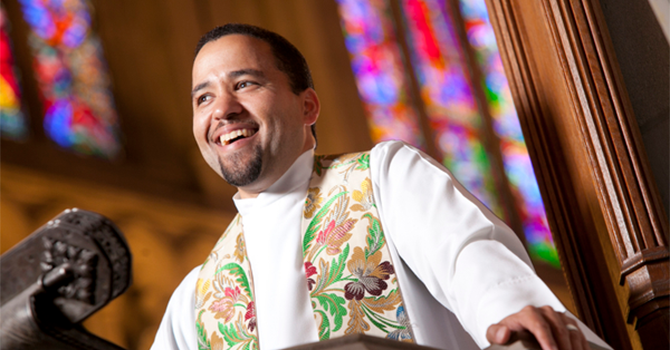

Editor’s note: Faith & Leadership offers sermons that shed light on issues of Christian leadership. This sermon was preached at Edenton Street United Methodist Church in Raleigh, N.C., on April 15, 2012.
I’ve consistently held a job since I was about 12 years old. In fact, I’ve lost count of just how many different jobs I’ve had, but there have been plenty -- everything from baby-sitting to setting skeet at the local hunting club.
I’ve delivered newspapers, done landscaping and worked retail. I’ve served ice cream, fast food and fine dining and have been employed at college libraries and an admissions office. In more recent days, I’ve worked for a food assistance program and a philanthropic foundation and served as a hospice chaplain.
I suppose the reason I’ve given so much of my time to work is that I’ve always believed in it. Even if I couldn’t articulate why, I knew that somehow life was more meaningful because of work, not less. It feels good to work. I understand the folks who win the lottery and keep their day jobs anyhow. I probably would, too.
And yet over time, I’ve also discovered that work can become meaningless. Regardless of what it is that you do, work can quickly begin to feel like the plight of Sisyphus, from Greek mythology, whose punishment from the gods was to roll a giant stone up a hill only to watch it roll back down, repeatedly, throughout all eternity. Does that sound familiar to anyone?
It reminds me of the worst job I ever had, working on the assembly line of a frozen-pizza company, in which my assigned task was to pick up a box of bread from a stack behind me, turn back around with the box, flip the contents out onto the conveyor belt now in front of me, discard the empty box and then repeat. That was the whole gig. And since the machinery was incredibly loud, everyone had to wear ear protection, so there was no communication all day.
But the truth is that whether you’re on an assembly line or preaching behind a pulpit, there are plenty of days when you wonder why you do what you do and whether it deserves so much of your life.
Unfortunately, the church has not always done a great job of addressing this issue, and sadly, the research shows that one of the primary reasons my generation is leaving the church is because we have largely ignored the arena in which people spend most of their waking hours.
Work resurrected
So this Easter, I’ve found myself asking the following question: “If resurrection changes everything, how does it change our work?” I’ve heard plenty of Easter messages about how resurrection proves that there is life after death, that sin is defeated and that Jesus is Lord, and all of that is foundational to our faith.
I take comfort in knowing that “it’s Friday, but Sunday’s coming,” but if you’re anything like me, perhaps today what you’re really thinking is, “It’s Sunday, but Monday’s coming.”
In 1 Corinthians 15, the apostle Paul provides us with the most extensive explanation of resurrection in the Scriptures, discussing all kinds of things, from what resurrected bodies will look like to what’ll happen to the folks who are still alive when Christ returns.
But it’s his final conclusion regarding resurrection that I would like to turn our attention to, in which he writes: “Therefore, my beloved, be steadfast, immovable, always excelling in the work of the Lord, because you know that in the Lord your labor is not in vain” (NRSV).
Did you catch that? According to Paul, because Jesus is resurrected, it then follows that we should fully give ourselves to our work.
For most of us, the logic isn’t exactly obvious. What does Jesus’ resurrection have to do with our work? As I’ve wrestled with this, I’ve come to see that perhaps one reason why the connection isn’t more apparent is because many of us learned a version of the Christian story that’s missing some very important pieces. (Stay with me for just a couple of minutes.)
The Christian story as many of us learned it goes something like, “All have sinned and fallen short of God’s glory, but God took on flesh in the person of Jesus, paid our penalty through death on a cross and was resurrected, and now, if you believe in him, you can go to heaven when you die.”
Now, if you live according to that story, one subtle conclusion is that the earth and everything we do on it will eventually be done away with, and thus our work is basically meaningless. The one exception, of course, is the eternal work of saving souls.
According to this premise, many of us have come to talk as if the “soul-saving” business of the church were the really important work in the world, and all other vocations significant only insofar as they help fund the work of the church. If that view of work frustrates you, good! It should. It frustrates me, too.
The problem with that account of the Christian story is that it completely skips the first and last two chapters of the Bible. Imagine if you did that to your favorite movie or book!
You see, our story doesn’t begin with sin but with God creating a very good world, and it doesn’t end with creation being discarded but with all of creation being renewed. It turns out that those chapters are actually really important, and when we put them back in the story, the picture we get regarding this life is very different. In this story, it’s not just souls that God is saving but all of creation.
This then means that what happens here actually does matter. And here’s where Easter Sunday comes in: Jesus’ bodily resurrection is the sure proof and foretaste of that reality. Jesus doesn’t rise from the grave in some purely spiritual form but in the very body he left with, scars and all.
Granted, some things have changed -- now he can walk through walls -- but it’s still his body, which indicates that this world and what happens here is connected to the next life.
And so Paul says, “Look! Resurrection proves that what we do here matters, so get to work, because in the Lord nothing is wasted. It’s Sunday, but Monday’s coming!”
Meaningful work
Therefore, the invitation this morning is to give yourself fully to the work that you’ve been given, since “you know that … your labor is not in vain.” You see, work is inherently meaningful. It’s part of what it means to be made in the image of God.
Adam and Eve had work to do before sin made it frustrating, and we’re told we’ll continue to work in Christ’s coming kingdom. Work, believe it or not, is a privilege you’ve been blessed with.
My favorite commercial right now is a short documentary by GE Aviation, in which a number of employees who work on an assembly line making jet engines are interviewed. They talk about being intrigued by flight, about being inspired by the opportunity to help lift people to 35,000 feet and make the world a smaller place.
Now, remember, these are folks who spend their days tightening bolts and making welds. But it’s clear that they’ve realized it’s about more than that; they’ve given themselves to something bigger.
The ad ends with the employees standing on the runway of an airport. And as they stand there, watching a commercial airliner take off with their engine strapped to it, they applaud and cheer, some with tears in their eyes, seeing the fruit of their labor, some of them for the first time.
My favorite line is when a woman says, “You know, when most people look at a jet engine, they just see a big hunk of metal, but I see Seth, Mark, Corrine and Tom.”
You too have been given something to do, something that you’re specifically gifted for. And don’t believe for a second that there is a realm in this whole world that God isn’t using in his great restoration project. Every single form of work that anticipates God’s future kingdom is inherently meaningful. Scripture even compares God to a metalworker, a garment-maker, a farmer, a shepherd, a winemaker, a builder and a musician. Not to mention that Jesus was a carpenter for most of his life.
If we would believe this, I’m convinced it would change us. It would change our work, our church and even our city.
Imagine if we began to see all forms of work as vocation. Perhaps we would begin to invite not just our mission teams up front during Sunday worship for a prayer of blessing but also our educators in the fall, our accountants during tax season and our legislators during primary season.
What if we created guilds within our church for attorneys, artists and business folks, who could meet regularly to dream and pray about the ways in which the kingdom is intersecting their work? What if we developed mentor programs, where seasoned professionals could come alongside recent graduates to help them walk out their vocations faithfully?
I’ll tell you what I think would happen. I think we’d come to see that our work is absolutely meaningful. I think we’d be known in our city as a community of incredible employees and, ultimately, I believe it would change the industries we work in. All for the glory of God.
Benediction
So friends, it’s Sunday, but Monday’s coming, so go forth in the power of the resurrection to do the work that God has given you, as we await the coming kingdom, when we too will finally see the fruit of our labor, knowing that on that day we too will cheer with tears in our eyes, grateful to have been a part of God’s great renewal project of the world. It’s to this that you have been called.
Amen.