
Editor’s note: Faith & Leadership offers sermons that provide insight into Christian leadership. Ellen F. Davis preached this sermon on June 26, 2011, at Duke Chapel.
A thought experiment: If they had asked me to edit the Bible (whoever “they” is, perhaps the Holy Spirit or the heavenly Council on Divinely Inspired Works) -- if they had made me the original editor of the Bible, I would have made some substantial changes.
The very first change would have been to get rid of the 22nd chapter of Genesis, the story of the near-sacrifice of Isaac.
“It’s way too off-putting,” I would have argued.
“Just listen to this: ‘And God said, Take your son, your only son, the one you love, Isaac, and take him to some as-yet-unspecified place, and offer him there as a burnt offering.’ This is exactly the kind of story that gives the Old Testament a bad name,” I would have said. “It gives God a bad name. If you put this story just 22 chapters into the Bible, who is going to read the rest? Even if the story is true, who would want to believe in a God like this?”
Mine is a common-sense argument, which must have occurred to countless sensible people through the ages. Certainly, the literary and theological geniuses who put together the book of Genesis must have considered this argument and dismissed it.
Raising my sights, I imagine making my argument to the heavenly Council on Divinely Inspired Works, and after they had listened politely, they would tell me that I had completely missed the point. The point of this story is not to make people want to believe in Abraham’s God, who is of course also Jesus’ God and Father.
Rather, this harrowing story exists to help people who already believe make sense of their most difficult experience, when God seems to take back everything they have ever received at God’s hand. In other words, the Holy Spirit and the heavenly Council would tell me the point is not to draw people in but rather to help people who are already in stay in -- stay in relationship with the one true God, even when their world turns upside down.
This story appears front and center in Genesis, where no reader of the Bible can miss it, because the hard truth is that the world turns upside down for the faithful more often than we like to admit.
I remember the words of my young friend, a devout Roman Catholic, just a few hours after his first child had died in birth, strangled by her umbilical cord: “I could say, ‘Why me?’ But why not me? I knew this happens to people, and it never made me doubt God before. So why should I doubt God now? But still, I do not understand.”
The 22nd chapter of Genesis is the place you go when you do not understand at all what God allows us to suffer and, it seems, asks us to bear -- and the last thing you want is a reasonable explanation, because any reasonable explanation would be a mockery of your anguish.
This story of Abraham and God and Isaac is the place you go when you are out beyond anything you thought could or would happen, beyond anything you imagined God would ever ask of you, when the most sensible thing to do might be to deny that God exists at all, or to deny that God cares at all, or to deny that God has any power at all. That would be sensible, except you can’t do it, because you are so deep into relationship with God that to deny all that would be to deny your own heart and soul and mind.
To deny God any meaningful place in your life would be to deny your own existence. And so you are stuck with your pain and your incomprehension, and the only way to move at all is to move toward God, to move more deeply into this relationship that we call faith. That is what Abraham does. Without comprehension, nearly blinded by the horror of what he was told to do, Abraham follows God’s lead, for the simple and sufficient reason that it is God who is leading. To what end, Abraham has no idea.
It is quite common for theologians to hold up Abraham as a model of unquestioning obedience to God, but I think this is misleading, and possibly even damaging to Abraham’s character. After all, obedience is a virtue only if it serves a just cause. Obedience in service of an unjust cause is servile, cowardly, even criminal. That we learned definitively from Nuremberg and, in our own country, from the My Lai massacre. If it is purely out of obedience that Abraham submits to God’s command, then his willingness to submit is monstrous.
But there is another option.
What if Abraham follows God’s command, not out of obedience, but out of faith -- which is to say, what if Abraham trusts God, even now, when what God asks of him seems to run counter to everything God has promised? (For the child Abraham is called to sacrifice is the child through whom God’s promise of blessing is meant to unfold.)
It is trust, not obedience, that binds Abraham to God. This is something I learned from the great 20th-century Jewish theologian Eliezer Berkovits, who is one of the leading thinkers in Jewish theology after the Holocaust.
In his probing and wrenching book “With God in Hell,” Berkovits asks this question: Why did so many Jews keep their faith in the ghettos and the Nazi death camps? Why did they gather to say prayers and keep Sabbath or circumcise their children as a sign of the covenant, even as the SS literally beat down the door? Why did they keep blessing God as the Holy One of Israel instead of cursing the God who seemed to have abandoned the Jews?
As he puzzles over this question, Berkovits turns to this story of Abraham, and what he discovers is the bottomless trust that holds Abraham together with God.
Here is what Berkovits imagines Abraham saying to God during those three days of hell, as he follows God to Moriah, the place of unspeakable sacrifice:
In this situation I do not understand you. Your behavior violates our covenant; still, I trust you because it is you, because it is you and me, because it is us.
... Almighty God! What You are asking of me is terrible…. But I have known You, my God. You have loved me and I love You. My God, You are breaking Your word to me…. Yet, I trust You; I trust You.
What Berkovits shows, better than anyone I know, is how intimate is the relationship between God and Abraham. Abraham is with God in hell, the way two long- and well-married people are together in the worst moments of the life they share. The marriage metaphor is apt, because Isaac is the child of this union between God and Abraham, the miraculous child of the promise of blessing and offspring. And in the strangest of all paradoxes, that is why Abraham is ready to do what God asks, even to the point of taking a knife to his child.
Abraham trusts God totally with the life of the child they share, the life that God has given. In the midst of this life-shattering thing that he does not understand at all, Abraham knows only this: Life and life with God are the same thing.
Like the Jews who risked their lives to observe Sabbath in the death camps or to circumcise children in the ghetto, Abraham is incapable of choosing survival -- even his child’s survival -- over life with God. For better, for worse, it is simply too late for him to live apart from God.
Total, radical trust -- this is the only thing that makes any sense of Abraham’s submission to God.
But still you have to ask, Is God trustworthy? What kind of God would submit Abraham to this appalling “test,” as our story calls it? There are just two possible answers, and both are difficult.
One answer: a sadistic deity who takes pleasure in human pain. But that answer is biblically impossible. If God is a sadist, then the rest of the Bible is a lie, and so is everything we say and sing here in this chapel.
And so I am forced to choose the only alternative: God calls for this test because God needs to know -- desperately needs to know -- whether Abraham is completely devoted to God.
It is theologically unconventional to say that God Almighty needs to know something God does not already know, but that is the clear logic of this test. Remember, Abraham is the person on whom God has chosen to rely completely.
After the flood, when God almost gave up on humanity, after we had filled the whole world with violence, God decides to move forward in relationship with the world, but on this condition: From now on, Abraham and his seed will be the one channel for the dissemination of God’s blessing. Abraham is like a prism; he focuses God’s blessing and then spreads it through the world like a rainbow stream of light.
So now we see: God has staked everything on Abraham, even the whole world. Yet there is serious reason to doubt that Abraham has staked everything on God.
Abraham and God have been in relationship for decades now -- it is already a long marriage -- and there are signs that Abraham still does not totally trust God, that he is still looking out for his own interest.
You might remember those stories of Abraham passing off his beautiful wife Sarah as his sister when they are traveling in foreign territory. So Sarah gets taken into the royal harem as a concubine, not once but twice (Genesis 12:10-20 and Genesis 20), and Abraham gets protected status as her “brother.” God never told Abraham to do that. Abraham did it because he was scared; he might get killed if someone wanted Sarah, knowing she was his wife. Abraham put Sarah in that terrible situation because he did not trust God to pull them through the danger.
Abraham’s lack of trust puts God in a terrible situation, too.
Look, God is counting entirely on Abraham as the channel for overcoming evil in our world with divine blessing. But if Abraham does not entirely trust God, then all hope is lost. If Abraham tries to secure his own well-being apart from God, if he holds back anything, even his beloved child, and tries to protect him from God, then it would be better if the world had never been made.
That is what this test is about: trust, the delicate yet potentially durable link between God and ourselves, on which everything, even the whole world, depends.
Placed front and center in the Bible, this story makes it clear that the thing we call faith is not in the first instance a matter of what we think about God, any more than a good marriage or our deepest friendships are held together by what we think about the other. No, in every case the relationship endures only because two hearts are bound together through mutual trust. And trust is of course the very opposite of compulsion. Trust is how you relate to others when you don’t try to control them by force or manipulation.
The astonishing truth this story reveals is that God chooses to relate to the world not by compulsion but by trust. Yet trust is inherently a condition of vulnerability. You can be disappointed by the one you trust -- and deeply, deeply hurt.
God’s own trust makes God vulnerable. God is “grieved to the heart” by human evil, as the flood story in Genesis tells us (Genesis 6:6). We do not often think of God as needing to be courageous, yet it must take courage for God to stay in relationship with the world, as it takes courage for each of us to stay in relationship with God.
We have already experienced grievous disappointment, and we know that more pain lies ahead, in ways we dare not and should not try to imagine. Everyone and everything we love in this world is passing away -- later or sooner, we do not know.
Now you have to ask, What kind of way is this for God to run the world -- a way that is inevitably fraught with so much disappointment and pain on both sides?
And the answer is, This is the way of love, for mutual trust is the only environment in which love is wholly free to act. We know this from the earliest intimacy, the relationship between parent and child. Trust is the only environment in which love is wholly free to act for our good.
We know this also from the core biblical model of the relationship between parent and child. The absolute trust between God and Jesus is the environment in which divine Love is wholly free to act for our good. The God who is wholly Love chooses to trust us, so that the fullness of divine power may be unleashed to work through the lives of those who trust God wholly.
This is what we see in Jesus’ cross, death and resurrection: trusting love that suffers on both sides, and working through that love, God’s boundless power to save. As Christians have always seen, there is a story line that runs straight from Abraham, Isaac and God at Moriah to the cross and resurrection; it is the story of trusting Love on which the whole world depends.
Caution: Relationship with the real God, the God of Abraham and Jesus, is not for the risk-averse.
The book of Genesis puts it to us straight: Sometimes being in relationship with the real God hurts like hell. Sometimes it’s bewildering. We’ll be inching along in the dark, with no vision of where this relationship is taking us.
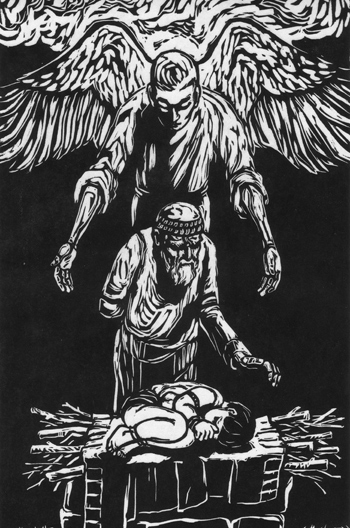
But the gospel also puts it to us straight: It is taking us to the cross and on to resurrection. It is taking us straight into the arms of God. The paradox of risky faith delivering us into the arms of God -- that is the paradox at which artist Margaret “Peggy” Adams Parker hints in the woodcut “And Abraham stretched forth his hand …”
See, Abraham has one hand behind his back, holding the knife, but he stretches out the other as if to caress his bound child, curled up as though asleep on the cloth his father laid down to protect him from the rough wood. And above them both we see what Abraham does not see: the angel stretching out strong protective hands to enfold them.
It is a picture of a child’s radical trust, a parent’s aching yet indomitable love, and the divine Love that will not let us go -- ever, not ever. You can put your trust in that.