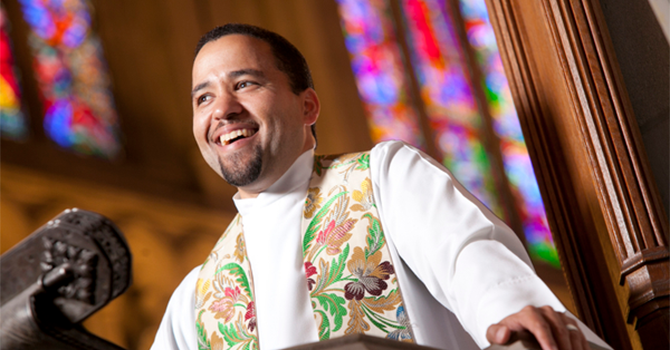

Editor’s note: Faith & Leadership offers sermons that shed light on issues of Christian leadership. This sermon originally was delivered by the Rev. Catherine A. Caimano on August 5, 2007, her first Sunday as rector at St. John’s Episcopal Church in Wichita, Kan.
Ecclesiastes 1:2, 12-14; 2:18-23;
Do you ever have those dreams where you are signed up for a class but you have forgotten to go all semester, and today is the final exam? For whatever reason, it’s always a math class for me. I hate that sinking feeling, when I realize that they are handing out the test and I am unprepared, the panic sets in.
I have to admit I have had dreams like that in these past weeks as I have been preparing to come here and be your rector -- dreams where the service was starting but I couldn’t find the door into the sanctuary, or I couldn’t find my sermon, or my prayer book was suddenly in Swahili. Well, so far so good on that front, I guess.
But this parable from Jesus always reminds me of those dreams: “This very night, your life is being demanded of you.” Uh-oh. The big final exam. Have I studied? Have I even remembered what I signed up for in the first place?
It is not a comforting thought. In fact, I love the feeling of relief that I get when I wake up from those particular kinds of dreams: “Thank God it wasn’t real, everything is back to the way I expect it.” And yet, Jesus promises us, someday it will be real. Someday, our life will be demanded of us. In fact, Paul goes so far in Colossians as to say that right now we are actually dead, that we won’t truly be alive until that day when we meet Jesus in the resurrection.
Yet I find it interesting that when we hear this, we often tend to go to the place of our anxiety. What if I have done it wrong? What if I have been looking at the wrong things, valuing the wrong things? And, of course, the tone of this parable is exactly that -- be on guard.
So it seems natural that we would approach our lives with God checking and double-checking, living in a perpetual waking anxiety dream. Will God catch us doing what we shouldn’t, like storing up treasures? But wait, who among us does not have a bank account? In fact, aren’t we constantly bombarded with messages that we should be storing up our wealth, so that we will have enough to get by, so that we won’t be caught unprepared in our earthly life?
So then our anxiety becomes: Are we doing right by God or are we doing right by the so-called real world? No wonder we have nightmares.
And yet, I get the feeling, given how this whole story comes up in the Bible -- someone is asking Jesus to be the wise king, the arbiter of disputes, and he turns the tables, as he often does, and tells them a story instead -- that Jesus isn’t trying to add to our fears, but to alleviate them.
In fact, just after this parable, he goes on to the more familiar passage where he exhorts us not to worry about what we will eat, what we will wear -- to “consider the lilies.”
In all of this I think that Jesus is telling us that our life with God is not just another realm where we have to wonder if we are getting it right; instead, he is saying that most of our anxieties are unfounded because the only real world in which we actually live is the kingdom of God.
And what makes us Christians different from everybody else is not that we don’t have savings accounts; it’s that the true saving in our lives is the salvation of a God who died for the love of us. And so our life consists of something more than what we can store up on earth. And our true life is still being revealed to us, every day.
“This very night, your life is being demanded of you,” says Jesus, who knows in saying this that our lives really belong to him, and he wants us to know this, too. And so he exhorts us not to get too caught up in our earthly anxieties because there is so much more to what we are here for.
And God’s dream for us, I think -- and it is a good one -- is that we live to discover this.
I love how Jesus puts it in this parable -- the rich man in the story is not criticized for storing up his treasures; he is criticized for storing up his treasures while not being “rich towards God.” I think we are so used to being grateful for the abundant ways in which God has blessed us that we can forget that this goes both ways, that part of discovering our true lives is to give our gifts back to God and to the world.
That in this we have the chance to ponder a life -- not where we wake with a start to find out what we are lacking -- but where we open our eyes to find that our life is more than what we see around us, more than what we can count, that what we possess is beyond even what we can imagine.
Storing up our treasures is fine as far as it goes, but our real value as Christians is what we risk living into our faith. When we are rich towards God. And as far as I can tell, as Christians this involves some very specific tasks: loving God and loving one another above all. But also forgiveness, generosity, gentleness and hospitality.
And not just believing in these things, but living them. Incorporating them into our work and our play, our learning and our rest, our family and our friendships. And not because we have to. Not “or else” -- or else we will wake up and find a condemning God who is our worst nightmare. But because we know that this is the way that we truly discover the dream that God has for us, the kingdom of God that is here for us now, our true life and our true life’s value.
Lots of people have asked me if I will be changing things here at St. John’s, and the short answer is yes. Mostly, I think, in ways that none of us even expect. Since I am new to you and you are new to me, there will be lots of little things that each of us think of as “normal” that will nonetheless come as a surprise when we find that our ideas of “normal” are not completely the same.
But some of it will be intentional, as together we decide how we will live our lives being rich towards God. I promise you that I am going to challenge us all to look every day at the things we do in our so-called “real” life -- our work, our finances, our families, everything, individually and collectively -- and ask ourselves if we are orienting our life towards our faith, if we are living as if we really believe that God is providing for us, that Jesus has risen for us.
I am going to ask us to ask ourselves every day, “Is this who God wants me to be?” -- not because we are afraid that God might be disappointed in us, but because of our joyful belief in all the good things that God has in store for us.
I would like to suggest to you that this is part of the dream that God has for all of us -- the one where we wake up and say, “Thank God, this is real. The life of love and forgiveness and reconciliation and resurrection is the only real thing that there actually is.”
This very day our lives are being demanded of us. This very moment our lives are being demanded of us. Our real life. The one where we realize that nothing is as valuable as the love of God. The one that we dream of, and that God dreams for us.