
Health and wellness was an integral part of the ministry of the Rev. John Wesley, the founder of Methodism, said Randy Maddox, a noted Wesley scholar.
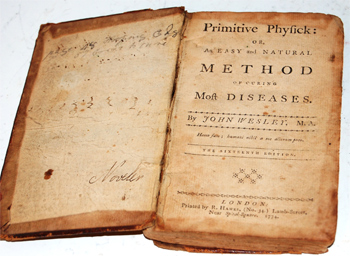
Indeed, Wesley’s most popular publication in his lifetime was “Primitive Physick,” a book of medical advice.
“Wesley is convinced that God cares about the whole person,” Maddox said. “He doesn’t see the spiritual and the physical as separate.” Wesley believed that God wanted human flourishing in every dimension, indeed, the flourishing of all creation.
That emphasis on integrating the ph ysical and the spiritual is just one of the many lessons Wesley’s writings and thinking on health offer the church today, Maddox said.
Maddox is the William Kellon Quick Professor of Wesleyan and Methodist Studies at Duke Divinity School. He spoke with Faith & Leadership about Wesley’s interest in health and wellness. The following is an edited transcript.
Q: People today might be surprised that Wesley was interested in and wrote about health and wellness. Was that unusual in his day?
Of all Wesley’s books, the one that stayed in print the longest and went through the most editions wasn’t his sermons or hymns. It was “Primitive Physick,” a book on medical advice. It was central to his work.
Today, spiritual care is done by pastors in churches, and physical care is done by physicians and nurses in hospitals and clinics. But you would not have had that separation before the 1700s.
In most villages in early-18th-century England, the pastor was the only person with any college education. Anglican clergy were responsible not only for the parish’s spiritual care but also for physical care. Part of their job was to give health advice.
The word physick or physician didn’t describe the person who gave you medicine or did surgery. It was the one who gave you advice about how to maintain health, and then you would go to your local apothecary or to a barber-surgeon or whatever. That was part of the pastor’s duty, and they understood it in the sense that God cared for the whole person and they should too.
When John and Charles Wesley trained at Oxford to become Anglican clergy, one of the required subjects they studied was medicine, or physick. We know that John in particular continued to read books on physick.
When he came to Georgia to serve as a pastor, one of the books he read to prepare was on plants and herbs that grew in the New World and their medical usages, so that he could give this kind of advice.
Q: Given the primitive nature of medicine at the time, people were probably better off seeing a clergyperson.
Eighteenth-century England is when the professionalization of medical care began to emerge. Many people were hanging out a shingle and saying, “I can do surgery; I can give medicines.” Some were good and many were quacks, but how do you know?
But yes, few folk in the villages had any serious training that enabled them to give wise advice. Even if they did, many accepted medical treatments were not helpful. Bleeding, for example, was a common treatment, meant to restore the balance of humors. Some also recommended taking mercury, which is a poison.
The “Primitive Physick” is basically a listing of various ailments and possible treatments. If you have a sore tooth, here are some things you might try. When you look at the suggestions, many strike you as common-sense -- and a few strike you as kind of weird.
A lot of earlier scholarship on Wesley assumed he was collecting old wives’ tales as he rode around England, but we now know that he took most of these from the standard medical textbooks of his day.
He was trying to distill the wisdom that he had learned at school and make it available for those who didn’t get to go to Oxford. Compared with other books of the period, his is pretty cautious. His advice was much safer than the advice people got on the streets.
Q: Some scholars dismiss his work on health and healing, but you contend it was a central part of his ministry. How so?
First, Wesley is convinced that God cares about the whole person. He doesn’t see the spiritual and the physical as separate. He actually differed from his brother Charles on this.
There was a strand of Puritan thought that assumed that whenever we had a physical ailment, whatever its physical cause, the ultimate cause was God. Illness awakened us to our spiritual need. We were to learn lessons from it, including not being too attached to this life.
If you understand illness that way, then trying to relieve or cure it could be seen as working against God’s purposes. Many of Charles Wesley’s hymns around illness basically say, “Lord, teach me the lesson I’m supposed to learn from this.”
But John is clear that God wants health for all God’s children -- health of soul and health of body.
Q: In this life.
Yes. He recognized that we won’t have perfect health forever and that we all eventually die, but he believed that God wants good for us and provided means to support that.
Wesley sees this life as a foretaste of what will be in the next. If the next life is to be a life of flourishing of body and soul, then in this life God also wants us to work toward a flourishing of body and soul, and that’s what Wesley encouraged people to do.
Q: You’ve written that Wesley’s views on health were part of his holistic view of salvation. What do you mean?
He comes to that view over his lifetime.
When you look at early biblical models about what God wants for creation, it’s clear that God wants a flourishing of the whole creation. Not just humans, but all creation.
While that view carried over into the early church, so did others, including certain strands from the Greek tradition that suggest that only the spiritual is real and enduring, and that the physical is at best something not valuable.
Over time, many Christians bought into that view. They came to believe that our eternal state will be one where we leave the body to exist as disembodied spirits with God the eternal spirit.
You see that in Wesley’s early writings, where he talked about, “I’m a spirit come from God returning to God.” But as he studied biology texts of his day, he became convinced that creation is rich with things that God must have placed here because God valued them.
In his later years, he recovered the theme that God offers salvation not just to humans but to the whole creation. He preached a very influential and famous sermon called “The General Deliverance,” about animals participating in God’s eternal salvation. He makes the point that if God cares about animals, then we ought to care about them. We ought to imitate the God whose mercy is over all God’s works.
Similarly, if you believe God cares about the whole person -- body and soul -- then we should care about the whole person, and the church should structure its ministries to address both the spiritual and the physical health of people.
Q: Tell us more about the book.
Wesley was using the word “primitive” in the common usage of the time, meaning that which is pristine or goes back to the original. He was trying to offer medical advice that had been used for generations and that went back, as he understood it, to the roots of creation.
Wesley particularly wanted to offer care to the poor who didn’t have access to the few “professional” physicians -- certified by the Royal Society -- who were in and around London.
He would point them to things like honey or sometimes to specialized things like Peruvian bark, which is the source of quinine. Most things he suggests are herbs and minerals that you could find in the forest or at your local apothecary, and also all kinds of exercises.
For each ailment he gave four or five treatments, so if you didn’t have access or one didn’t work, you could try another.
To understand the book, it helps to understand what Wesley was doing before he wrote it. After he left Georgia and returned to England, he never again served as a parish priest. Instead, he gets caught up in this revival movement and spends the rest of his life as a traveling evangelist-organizer.
Early on, he noticed that the meetings attracted a lot of poor people who didn’t attend parish churches. Many were sick, and since they didn’t attend church, they didn’t have the connections to get health advice from a priest. And they didn’t have money for a physician.
He felt that he needed to care for these people, so he opened a clinic in Bristol and later in London, and a dispensary where people could get medicines. But as the movement grew, Wesley spent most of his time traveling around England meeting the Methodist societies, and he began to wonder how he could still do this.
That’s where the “Primitive Physick” came in. He put into a book the advice he had been giving verbally and then added to it over time.
He told his assistants in each region -- basically, lay preachers -- to leave two books in every home for spiritual and physical care: “The Christian’s Pattern,” his abridgment of Thomas à Kempis’ “Imitation of Christ” and “Primitive Physick.”
Q: Much of his advice still makes sense. He’s a big advocate for physical exercise, which researchers today call the most powerful anti-aging medicine.
Yeah. Wesley believed that God wants you to be an active participant in God’s transforming work. So both spiritual and physical exercises were an important part of early Methodism.
In his letters, he wrote that exercise was the most important way to cultivate the health of both body and soul. And he gave specific advice in the “Primitive Physick” about the types of exercise to do -- walking outside every day, getting your steps in, riding a horse. He recommends several, many of which are cardiovascular in nature.
Q: What was the pastor’s or the regional leader’s role?
In Wesley’s day, Methodism was kind of a parachurch movement. Wesley encouraged the movement’s traveling preachers to give advice but also leave behind the book. And he also set up in each local setting a position called the “visitor of the sick.”
It was usually a woman who visited the sick and drew upon the “Primitive Physick” or other resources to help meet their spiritual and physical needs.
But you could also say that the “preacher’s” role was to hold up the ideal. In many ways, even today, the most important thing preachers can do is articulate an understanding of God’s purposes and will that doesn’t separate the spiritual and the physical.
If everything we hear on Sunday is about the spiritual dimension of life and getting to an eternal rest, and nothing about caring for the whole body, it can encourage that separation.
Q: Ironically, some clergy today tend to be less healthy than much of the population. Did Wesley have specific advice for his leaders?
Wesley was very direct in letters to his lay preachers and clergy colleagues, charging them to care for themselves, to make sure they got enough exercise, good diet, proper sleep.
He did that partly because every Christian should do this, but he was also specifically telling pastors, “You won’t be able to carry on your ministry unless you take care of yourself.”
What I don’t find much of in his letters are reminders to find times of rest, of recreation. Wesley is clear about resting on the Sabbath, but otherwise his model tends to be, “Get a good night’s sleep, and when you get up, get to work and work all day long.” That was what he did. He tended to look upon rest or recreation as frivolity.
So we need to speak a word back to Wesley, and that is a word of balance. His drivenness had a negative impact upon his [failed] marriage. His brother Charles recognized that he couldn’t give proper attention to his role as father and husband if he was on the road nine months a year and so strived for a better balance.
John, though, was married to the movement and was probably better off being single. Most of us need more balance than he had.
So we shouldn’t look to Wesley as the ideal model of balanced pastoral life. Some clergy have inherited the notion that they’re supposed to give 24 hours a day to the church, and there are elements in Wesley that could feed that problem.
What he does help us do is to re-integrate the spiritual and the physical and to stress holistic care for ourselves and in our ministries.
Q: What are the lessons for the church today?
First, that God cares about body and soul, that we are created in such a way that the spiritual and the physical are interdependent.
Second, Wesley was concerned not just about how we heal that which is sick or broken but also how we nurture sustaining practices of health. He stressed that we ought to practice proper diet, exercise and sleep in order to cultivate health, that God created and sustains us, and expects this of us.
It’s about human flourishing in every dimension, indeed, the flourishing of the whole creation. One insight that I don’t think he realized as deeply as we do is that our care for ourselves is tied up in our care for creation. If we don’t care for the creation, that too comes back to our physical detriment.
Finally, Wesley wanted to make sure that good basic care was available to all people. He designed the “Primitive Physick” and the work of the visitor of the sick and things like that to reach out to those who didn’t have access to or the means to purchase care.