Update: Jan Love stepped down as dean of the Candler School of Theology in 2024.
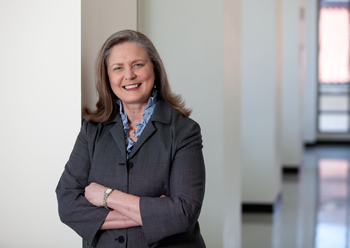
Conflict is inevitable, and trying to end it impossible. That’s why managing, handling and transforming conflict should be a goal, said Jan Love, dean of the Candler School of Theology at Emory University and professor of Christianity and world politics.
“Conflict transformation doesn’t presume an inactive or non-active engagement with the world, and it doesn’t presume a nonconfrontational stance with the world,” she said. “But it does presume that we don’t have to stay in destructive conflicts, that they can be transformed to be creative and positive.”
Love, a political scientist and former chief executive of the Women’s Division of the United Methodist Board of Global Ministries, took over as dean of Candler in 2007, becoming the first woman to lead the United Methodist seminary.
Love holds a doctorate in political science and international relations from Ohio State University and spent much of her academic career at the University of South Carolina.
In addition, she served on the Central Committee of the World Council of Churches from 1975 to 1998 and was a director of the United Methodist Commission on Christian Unity and Interreligious Concerns from 2000 to 2004.
Love was at Duke University to give a plenary talk at the Center for Reconciliation’s Summer Institute. She spoke with Faith & Leadership about conflict transformation, Candler’s new global strategy and why she has amassed a collection of art during her tenure at Candler.
Q: What is conflict transformation?
Conflict transformation is an acknowledgement that conflict is endemic to all aspects of life and human community, and even community outside of human community. So if you take a perspective of the whole of creation, it’s unavoidable and it’s often uncomfortable -- conflict is -- but it can be handled and managed in a way that it gets you to new creative outcomes rather than having a destructive influence in your life.
A lot of the literature in international relationships and political science has for almost a couple of generations now talked about conflict “resolution,” conflict “management” and those kinds of words.
But I would say in the last decade, maybe a little bit less, the literature started talking about conflict transformation, that is, comprehending that we’re never going to resolve all conflicts, and we’re certainly not going to get to some perfected state of human condition where conflict goes away.
So how do we transform the communities in which we live, the relationships in which we live, into ever more productive communities and relationships, and positively productive ones, by the creative use of conflict?
Conflict transformation doesn’t presume an inactive or non-active engagement with the world, and it doesn’t presume a nonconfrontational stance with the world. But it does presume that we don’t have to stay in destructive conflicts, that they can be transformed to be creative and positive.
Q: So is this something that you employ in your work as dean, or is it more of a theoretical issue?
It’s a daily exercise and experience. Good managers, I think, are good at transforming conflicts. They may not call it that, but one of the techniques is always just to shift the nature of the discussion, if you’re locked in battle over some concept or some idea or some relationship or some inability to get a particular issue tackled.
If you can step back from it, shift the nature of the discussion for a little while, you can often envision an outcome that involves a third or a fourth or a fifth way of imagining what’s going on here and then transform whatever [issue] is at root.
Mediation is often an important part of conflict transformation, getting help from somebody else to get parties to a conflict to see themselves in a new light, to see a way forward in a new light, things like that.
There are a lot of techniques. I make jokes, now that I’ve been managing people for a long time, that some part of managing people is not unlike dealing with 2-year-olds. I think any parent who’s been engaged in raising children knows something about conflict transformation, knows something about helping people find ways through tough issues and difficult processes that moves them beyond themselves into good places.
Q: This seems to overlap with your various areas of expertise, including global issues and conflicts. I know that at Candler you’ve been globalizing, or internationalizing. What is your strategy?
We are involved in internationalizing our curriculum in a very deliberate way, and we’re just beginning on that journey.
In some respects, any academic discipline has always been international -- I mean, to read the New Testament in Greek is an international experience, for example, or to read the Old Testament in Hebrew is an international experience.
But what we’re keenly interested in now is having long-term, sustained and sustainable -- from a financial point of view -- relationships with seminaries in other parts of the world that simultaneously put us into deeper relationships with similar if not almost identical communities in the metropolitan area of Atlanta.
So that Latino immigrants, of which there are many in Atlanta, could well teach us as much about relating to Latin communities in South America if we would bother to go be immersed with them for as long as it would take to do a mission trip to Argentina or Chile or Brazil or any of those areas.
And we intend to do both, so that Candler students get the positive and very powerfully productive experience of dislocation in other countries, which is one of the most educationally useful parts of travel, but they also get to comprehend that that same community, if we opened our eyes and our ears and our hearts to them, are literally sometimes down the street.
And the United Methodist Church, certainly, needs more leaders who can navigate the worlds, the variety of worlds, that are now coming together. In almost every locale where we are, people from various parts of the world are congregating.
I think part of the quality of good leadership in the 21st century is being able to deal with the real world around you, of many peoples who come from many different places and look differently, speak differently, think differently sometimes, but they occupy an approximate geography.
And we can’t spend all of our lives traveling abroad. But we can be faithful leaders in God’s mission in this world to find those places that need the good news close to home, and that can be across the room, across the street, across town, across the state.
Q: To shift the conversation to another topic -- I understand you have been collecting the work of artist John August Swanson at the school. Why is it important for an institution to have art, and why this particular artist?
We had a new, five-story building with lots of wall space and a new opportunity to display art. I went to meet Swanson in the summer of 2007 and was very taken with him as an artist, and with his stories, and with his art. I discovered that it has a very powerful theological impact.
So I started purchasing from him his art that deals with Bible stories, because my vision was that students would be able to read the Bible by walking the halls of Candler and see Bible stories in a way that perhaps had not occurred to them before.
And so I began collecting it, and we now have 58 pieces. When he realized that we had so much space and we had such keen interest, he just started sending us stuff, too. So we now have the largest collection of Swanson pieces.
I kind of inadvertently made Candler into a place that is very special for Swanson art, and we’re thrilled about that.
But the intention from the get-go was to get a few pieces that would just open the world up to each of us as followers of Christ through media other than reading, writing and talking, or singing or worshipping.
I can’t imagine my faith journey without singing, for example, and without worship. Those are absolutely key in my life. But it’s also clear to me that we can have insights about the tradition, fresh insights, very old and ancient insights, as well as our own faith journey through artistic expression, and so it’s been a real joy to be able to bring that to Candler.
Q: The way you describe it, it’s almost a new version of the original purpose of stained glass in churches.
Right. The academy, of course, features in reading and writing, and necessarily so, but to get beyond that and to deeply moving artistic expressions can be very moving.
John Swanson’s mother was Mexican, and his father was Swedish. They spent a lot of time in Europe, so there’s a lot of influence of iconography in his art, and there’s enough androgyny in most of the figures that he portrays that I find them really engaging and invitational.
And he has a philosophy about his art that he wants to invite you into the story. What a wonderful way to think about the Bible, that we’re invited into this story of God’s work.
It has been a fun project, and more. It’s growing.
Q: And why do you think it has been successful? Do faculty and students respond to it? Or does it become just the background?
I think both. We have faculty who use it in teaching. We’ve used it in worship. And so we pull it out very intentionally on occasion and use it, but it’s also just the halls that people walk, all of that.
One of the pieces that I love to talk about most I’ve put on the fifth floor, which is where the executive leadership of the school is.
It’s a [serigraph] portrayal of John’s passage of the night of the Last Supper, and Jesus is washing feet, and there are 14 people in it. So students say, “Is he confused? Can’t he count?”
So when we asked him that question, he said, “Are there 14 people in there? You mean Jesus and 12, and then there’s an extra one? Well, that must be you.” So he does want to invite you in.
The other portrayal actually is a whole crowd of people. It’s 20-some-odd people, and so you can really imagine the community of Christians offering each other the radical hospitality of washing the feet in the spirit in which Jesus did that among the disciples.
So there’s just endless ways to pull on it for theological discussion, biblical discussion, personal insight and all of that.