
Editor’s note: In June 2020, nearly three dozen people alleged that they saw or experienced “spiritual and psychological abuse" by Christopher L. Heuertz; he posted a public apology on his webpage in which he acknowledged that some of his friendships with women “became inappropriate in nature.” A later investigation by an independent, third-party investigator on behalf of Gravity found no evidence of misconduct. Gravity is no longer in operation.
Chris Heuertz’s body is in Omaha, but his mind is in Peru.
The international executive director of Word Made Flesh is facing one of the many unexpected challenges that come with running a mission organization with a presence in eight countries and 107 people on its payroll.
“Sorry the office is sort of somber today,” Heuertz said. Normally the mood in the Word Made Flesh office is buoyant, as befits an organization intent on remaking the world. “One of our community in Peru has cancer.”
Heuertz learned that the woman in Peru needs $9,000 for her hospital bills in order to leave the country. Hoping to fly her to Stanford University for treatment, Heuertz was on the phone trying to reach people in his network who might help.
The exchange reveals a lot about Heuertz and Word Made Flesh. The ill woman is not an employee or even a fellow missionary; she’s a community member. Heuertz has responded as befits a genuine church that stretches around the globe.
Heuertz, 37, both leads and embodies the organization. As part of the “new friars” movement, WMF models its radical way of life on saints Frances and Clare with their rejection of wealth, personally risky enactment of peace and embrace of the poor.
Rejecting the idea that missionaries bring salvation and services to benighted poor people, WMF has learned from Christian tradition that the poor are Jesus. Word Made Flesh missionaries -- or “Fleshies,” as they sometimes call themselves -- do not necessarily seek to fix poverty or to convert people. Their first intention is to seek friendship with the poor. And through that they seek, with their friends, to be converted anew to God.
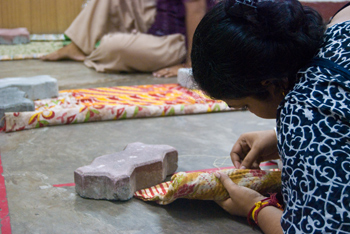
Its ministries include a community care center in a red light district in El Alto, Bolivia; a program for women in the sex trade in India to turn saris into art; homes for formerly abused and neglected girls and widows in Kathmandu, Nepal; an agency to help with micro-loans and home construction in Lima, Peru; and physical therapy for disabled people in Freetown, Sierra Leone.
Ministries such as these are not original. What is original is the care with which WMF talks about friendships with the poor as its main goal.
“Missionaries have always been concerned with the poor,” said Dana Robert, professor of world Christianity and mission at Boston University School of Theology. “What is different here is not the work, but the way of explaining it, of putting it forward as a first priority.”
Angels unawares
Much of Heuertz’s vision comes from his struggling middle-class-Catholic-turned-evangelical upbringing in Omaha and a series of dramatic experiences that led him into friendship with the poor as a way to meet Jesus.
His parents, Linda and Larry Heuertz, modeled Christian charity in their own home, adopting two children who had been abused. They also have four biological children. Now his parents run Hope for Sudan, which resettles Sudanese refugees. Chris Heuertz experienced poverty first-hand as well: At one point, Heuertz’s parents worked seven jobs between them, largely to pay for private school tuition for their children. If Chris wanted to speak with his dad, he went down to the convenience store where Larry Heuertz worked the night shift.
“We learned to be thankful for grilled cheese and fish sticks and shoes without holes,” Chris Heuertz said.
But he also experienced miracles. Heuertz survived spinal meningitis and encephalitis at age 11. Doctors said he probably would die, and if he survived he’d be paralyzed. Defying that predicton, Heuertz recovered and walked out of the hospital.
Later, when he was a teenager, Heuertz’s parents stopped to pick up a stranger on the way home from church. They took the man to his destination and delivered their children a lesson in helping “angels unawares.” The passenger turned out to be a new senior medical director at Mutual of Omaha, who later paid Heuertz’s tuition at Asbury College, an evangelical, Wesleyan school -- which his parents could not afford.
“None of us should be here,” Heuertz said. “I do have an unfair chance at life, so I should give it back, and not live it for myself.”
Although he now describes Christ as “irresistible,” he once played the smart-aleck skeptic in youth group before converting to Christ during a mission trip to a Navajo reservation. It was visiting people in North America’s direst poverty, he said, that taught him to love Jesus.
There also were several to conversions to social justice. In college, he traveled to Jerusalem and played soccer with Palestinian street kids, who told stories of parents working as hard as his did -- with no hope of betterment for their children. And in 1993, he traveled the world to learn how Christians were ministering to the poorest of the poor, winding up among Mother Teresa’s Sisters of Charity in Kolkata.
Given this interest, it was natural for him to go to work for WMF, an upstart mission organization begun by an older student at Asbury with advice from Samuel Kamaleson, who was then a senior executive at World Vision. Word Made Flesh combined World Vision’s emphasis on holistic, community ministry with Mother Teresa’s passion for the poorest of the poor.
From 1994 to 1996, Heuertz worked with WMF to establish the first pediatric AIDS home for in the south of India, in Chennai.
Heuertz never meant to be an administrator, but in 1996 WMF’s founder resigned. It was either him or no one, so he left the mission field. He now sees his administrative work in the biblical image of the donkey that bore Christ into Jerusalem: It’s important, but only because of the One it upholds.
The reluctant CEO
Heuertz hardly looks the part of the CEO. Nor does he see himself as a pastor.
“I’m more of an activist,” he said. He does look that part: His arms and legs are covered with rings, tattoos and piercings and he sports a soul patch and long hair and graying goatee. One tattoo on his ankle he and his friends did themselves in college.
“It’s my prison tat,” he said, joking.
Heuertz is at home in gentrified downtown Omaha, where WMF’s office is in a beautifully rehabbed former factory surrounded by boutiques and bistros. Outsiders may associate the Nebraska city with Warren Buffett, steaks and insurance, but it also has a bohemian culture of downtown lofts and artists.
In the WMF offices, Heuertz’s space is filled with stuff -- from Star Wars figures to a personal library that includes works of theology as well as autographed volumes by Elie Weisel, Dave Eggers and Salmon Rushdie.
“We don’t take a vow of poverty,” he explains, somewhat sheepishly. “And I love books.”
Though he sees himself as an activist, he has discovered a surprising gift: administration.
Along with the theology, business journals such as the “Harvard Business Review” sit on Heuertz’s shelves. “But I love board theory,” Heuertz protests at the seeming contradiction.
When he returned to the United States in 1996, he found WMF was broke and limping along. Heuertz and his wife, Phileena, had thought they would spend their lives in India, but now found themselves back in the U.S. talking about WMF’s future with fellow Fleshies. They immersed themselves in the best theology they could find, talked about holding one another accountable, and decided as a community to hit what they call “a hard reset,” launching WMF 2.0, with Chris as its head. In 2002 WMF moved to Heuertz’s hometown of Omaha.
Since then, the organization has grown from a struggling band of idealistic recent college grads to an international organization with a budget of more than $2 million. It now employs 107 people and counts about 130 more in its extended community. Heuertz and others keep the focus meaningful to the people who they work with and for.
“I love organizational theory, but we don’t have to be about hierarchy -- we can be about expectations,” Heuertz said.
Word Made Flesh tries to fill organizational language with gospel meaning. WMF members don’t have job descriptions; they make “community commitments.” The organization has no “strategic plan,” but rather a “community tactical cycle,” drawing on the language of guerilla fighters as readily as it draws from CEOs.
WMF rarely has to recruit, unlike many other mission organizations. In a miserable economic year, its giving is up 15 percent. This is due both to Heuertz’s charisma and the vision he outlines compellingly in his speaking on campuses, in essays and books, including “Simple Spirituality,” and a book coauthored with Christine Pohl, “Friendship at the Margins,” due out next year.
Kamaleson describes Heuertz’s ability to draw others this way: “Leaders with 'focused vision' always generate manpower and material resources. They do nothing to draw attention to the 'vision'. The 'vision' draws them.”
The organizational structure reflects the work, which continues to be profoundly innovative. Although it has its headquarters in North America, only 40 percent of its members are North American and WMF in India always has had an all-Indian board. Evangelical in outlook and origin, it’s now about one-third Catholic.
Phileena Heuertz is herself a recent Catholic convert. Chris Heuertz -- who has been at times Catholic, evangelical and is now just a Fleshie -- attends Mass with her but does not commune.
Phileena is the pastoral heart of not only their marriage but of Word Made Flesh. She coordinates care of the worldwide community and functioned as its co-leader since 1996. She is about to publish her first book, “Pilgrimage of a Soul,” which is based on a pilgrimage in northern Spain she and Chris took in 2007.
She and Chris speak frankly of their decision not to have children -- a surprising one considering their evangelical heritage and their care for so many children worldwide. When Phileena met Mother Teresa, the older woman counseled, “Remember your own children should be first.” Phileena has remembered -- in a way Mother Teresa might not have imagined.
It is hard to find an organization this ecumenical -- Quakers and Episcopalians are on its board, and Heuertz has been asked to speak at Joel Osteen’s prosperity palace, Beyonce Knowles’ black megachurch church in Houston and an “open and affirming” mainline liberal church.
“It’s crazy, man,” he said, in the tone of Gen X familiarity he never drops. “I do think I have super strong opinions, and people know that, and I’m not super diplomatic, so I’m surprised. Here’s the thing -- churches as diverse as the ones that invite me all think I’m on their side. And I want to be. If we’re all on the side of hope.”
Challenging the model
Word Made Flesh aims to challenge the donor-receptor model of missions, in which Westerners parachute in and solve problems for poor people elsewhere.
“If I bring anything, it’s presence and hope,” Heuertz said. “We work to recognize the divine imprint in all humanity, then together we are all converted to God. I’m not bringing a poor kid with me to Christ. I’m following their journey to the places in God’s heart that break in the face of such suffering.”
Nor is what WMF discovers all dreary. “We’ve learned from the poorest people in the world how to throw the best parties,” he said.
The hallmark of the WMF method is listening, not talking. It sends people to trash dumps and brothels and shanty towns around the world, for open-ended and long-term commitments or for two-month intensives.
Heuertz describes it as a “federation, not a franchise.” That means people in each community shape the projects, unique to each place. In Peru WMF workers listened for seven years before building a community center. Street kids in Romania wanted skills at woodworking, stonemasonry and gardening, as well as lockers to store their things in because their nice clothes kept getting stolen.
There have been failures. Once, a mission in Thailand that was trying to help women trapped in prostitution pulled the plug. (Word Made Flesh was more successful with a later effort.)
“One of our people would sit there in the bar while her friends would service customers,” Heuertz said. “It was horrible.”
Heuertz speaks of WMF’s efforts to “fail forward.” Missionaries can feel pressure to report successes: baptisms, conversions, buildings built and so on. But WMF’s quarterly journal, The Cry, is often a catalogue of failures: children’s obituaries, women returning to the red-light districts, exhausted Fleshies.
“We’re not even sure how we would count our successes,” Heuertz said. “Do friendships count?”
The Rev. Samuel Menyongar, director of a Sierra Leone center that partners with WMF, describes Heuertz as someone who “brings himself to people.” Menyongar has seen Heuertz stay in a $3 per night Freetown hostel most Westerners wouldn’t touch. He has seen him sit with strangers, learn their stories and cry over their plights.
“He is a great man,” Menyongar said, “because he brings himself down to people’s level.”
Heuertz also tries to lift others up. Liz Ivkovich, a recent graduate in WMF’s Omaha office, described traveling with Heuertz to Cornerstone, an evangelical music festival.
“All the other speakers had printed out bios that their introducer would read. Chris brought people from the community here at WMF to introduce him,” she said.
Word Made Flesh’s appeal to young people and its ecumenical and holistic approach reflect several trends in mission, said Roberts, of Boston University.
“All great upsurges in mission have been made up of young people,” she said. But “young people are not interested in the theological arguments that occupied their parents.”
WMF is trying to create its own niche -- partly by using careful language for its work. Heuertz and other Fleshies talk about “our friends who are poor” and “women forced into prostitution” rather than “prostitutes.” They even worry that Mother Teresa’s phrase “poorest of the poor” stigmatizes too much and prefer to use the term, “vulnerable.”
Andy Crouch of “Christianity Today” describes Heuertz as having a “kind of zany, postmodern organizational genius -- the ability to build a coherent, durable, growing movement without triggering young adults' suspicion of institutions.”
Heuertz speaks and writes of his forebears among missionaries. He’s seen cemeteries in Asia and Africa filled with missionaries from Europe -- they often sailed with ready-made coffins. Later generations moved from career to community models, establishing boarding schools, hospitals and universities.
Now, Heuertz says, we’re in an age of Facebook causes, that allow people to feel good about themselves for making a few clicks from their computer. He doesn’t reject Facebook activism out of hand -- in fact he has benefitted from it -- but cautions that it does not replace a personal and lifelong commitment to the work.
“You won’t end injustice by combating it on Facebook, and in fact it disrespects human victims to think you will,” he said. “If we really cared we’d be captivated by people, and we can’t be that until we get to know them. That’s how we’re converted.”
For Heuertz, that commitment now involves less travel and more days like the one he spent scrambling to find help for the Peruvian woman with cancer. She is now receiving treatment at Stanford.
She now has what Heuertz understands as the essence of the elimination of poverty: freedom, in this case the freedom to receive top-flight medical treatment. He wants that same freedom for his friends worldwide. And once we know them by name, Heuertz argues, we will want the same freedom for them as well.
Questions to consider
Questions to consider:
- Heuertz speaks about how his past has informed his present calling and his understanding of vocation. How has your past done the same for you?
- Word Made Flesh has made befriending the poor an end in itself. Have you made befriending those whom your organization serves a priority?
- Heuertz has found surprising gifts within himself for his present work. What gifts -- known or unknown -- has your work called forth from you?
- What would it mean in your life and in your institutional work to “fail forward?” How might this change your usual response to failure or difficulty?