
In 2005, as then-City Councilman Roy Buol climbed the hilly streets of Dubuque, Iowa, knocking on voters’ doors in a run for mayor, he was thinking about sustainability. He and his wife had begun enjoying the birth of grandchildren, he recalls, and wanted to preserve this new quality of life for them.
As he campaigned, he asked voters what they wanted for Dubuque, and he was delighted with their answers.
“They said they were concerned with water quality, air quality, the social aspect,” Buol, who won the election, said.
In the 1970s and 1980s, Dubuque had been hit hard by recession, unemployment and racial tensions. By 2005 the city was thriving, but Buol found that residents were not complacent.
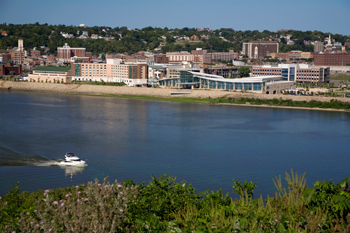
He interpreted voters’ concerns as subsets of an overarching desire for sustainability. Sustainability of the environment, yes, but also of all aspects of this city on the Mississippi River, which has garnered designations as the third most beautiful place in the U.S. (USA Weekend Magazine) and “the best small city to raise a family” (Forbes).
In response, Dubuque launched Sustainable Dubuque, which in turn sparked Smarter Sustainable Dubuque, a partnership with IBM to use analytics and cloud computing technology to help city residents.
Individuals, businesses and religious institutions have all taken part in the effort to make Dubuque, population 58,000, a model sustainable city using smart technology.
The goal? To save money and resources. The hitch? The program is voluntary. That is, no one has to take shorter showers or turn the thermostat down -- but they do.
Final data haven’t yet been released, but initial results from the electricity pilot program show a 4 to 11 percent savings rate, while the water pilot program is credited with saving the city $290,000. (The water program is being rolled out citywide now, and the electricity program will soon be implemented for all residents.)
How did city officials get citizen buy-in on a project that might -- at least in the short run -- cost money, for efforts such as fixing leaks and installing programmable thermostats?
The answer, municipal leaders, experts and ordinary citizens say, is simple -- yet challenging to replicate. The key to Dubuque’s transformation was meaningful citizen engagement.
Smarter Sustainable Dubuque
In 2009, IBM located its 1,300-job global technology service delivery center in Dubuque. Company officials offered three reasons for the city’s selection: Dubuque’s strong public-private partnership base, its colleges and universities, and the fact that the city’s sustainable model mirrored existing initiatives within IBM.
IBM didn't only bring jobs. The company extended an offer to the city: Would it partner with IBM to become the first “smarter city” in North America?
That, city leaders now say, was a no-brainer.
“We still had the bitter taste of the past in our mouths," said David Lyons, project manager of Smarter Sustainable Dubuque. "We wanted to maintain the [new] high quality of life for now and the future.”
SSD would pave the path into the future. Created to supply actionable information to Dubuque residents and organizations, SSD marries the research capacity of IBM with private Internet portals to collect and deliver data. That data -- gathered from water, electricity and gas meters, for example -- shows how much water is used in the shower each morning, say, or how much money it costs to heat the house during the day when no one is home.
IBM research staff member Tom Erickson said the purpose of SSD is to leverage the expertise of the people -- homeowners, businesses, schools -- to make systems run more efficiently. Whether the subject is “the patch of sidewalk in front of my house that needs repair” or the daily expense of electricity, Erickson said, gathering and sharing data helps create a “smarter” city that can “produce and distribute energy more efficiently.”
“Dubuque is a really interesting town,” Erickson said, “especially notable for the degree of collaboration and civic pride amongst the residents.”
That collaboration and pride were already in place thanks to Buol’s Sustainable Dubuque program. It had begun with an intense effort in meaningful citizen engagement.
“When the Council identified sustainability as a priority, the mayor appointed a 40-member citywide task force that was very diversified,” Dubuque Sustainable Community Coordinator Cori Burbach said.
Buol’s Community Sustainability Task Force -- which included representation from residents, businesses, schools, hospitals and other key organizations -- was charged with defining a sustainability vision for the entire city, with input from all of the stakeholders. Task force members did it by fanning out into neighborhoods, offices, libraries and coffee shops. They talked and listened. They handed out surveys. They posted information on the Web. They sent press releases to the newspaper.
“The people piece really tells the story of Sustainable Dubuque,” Burbach said. Lyons agrees. He said clear two-way communication coupled with the volunteer aspect of the programs resulted in a willingness -- even an eagerness -- to participate.
“We had to be able to clearly explain the ‘what’s in it for me’ piece,” Lyons said. That became clear during the survey process, as well as in initial feedback from program participants. “When we said, ‘If you make these three changes in your home, you can save $8.16 a month,’ that worked.
“We had to understand that not everyone is moved by the same issues,” Lyons said. “Money doesn’t move everyone. Some people are more environmentally conscious. If you partner with people, have conversations about what it means, you’ll see significant change.”
Exactly, said Bonnie Gordon, senior program director at MDC, a nonprofit in Durham, N.C., that helps communities remove barriers to educational and economic opportunity.
“Asking people to commit for the long term without a clear understanding of the value proposition is a setup for failure,” she said. “We talk with community leaders about the necessity of employing communication and data to inform, to consult, and, ultimately, to involve or empower.
“Common wisdom suggests that leaders get together, figure out a solution and deliver it to their communities -- and the historical roadside is littered with the failed results of these efforts, because that’s not what engagement means,” she said.
To make sure they were having clear, two-way conversations that would foster engagement, Lyons said, SSD rolled out a 12-home test before implementing the full water pilot. The feedback they received identified some potential trouble spots. For one thing, they found out that the language itself could undermine data results.
Participants, for example, couldn’t visualize “cubic feet” of water usage, as printed on their bills. “Gallons,” on the other hand, conveyed an image they could understand.
The city also discovered that a home’s ranking vis-à-vis other pilot homes was irrelevant to the homeowner unless the comparison was to similar homes. The new ranking is against homes that feature a similar number of square feet, rooms and residents.
“Your ranking at the top of the page is very powerful for people,” Burbach said. “People strive to get into the top 10. It’s [one way] to engage people, more than in financial savings.”
More lessons in meaningful engagement
The Community Foundation of Greater Dubuque (CFGD) was charged with the responsibility of getting the word out about SSD. Holding “community cafes” in libraries, bookstores, coffee shops and community centers, citizen volunteers and staff members presented information, answered questions and collected community feedback. In addition, they mailed printed materials, made phone calls and launched the Dubuque 2.0 website.
“Really, the key is grass-roots engagement,” said Eric Dregne, CFGD vice president of programs. “Partnership is in our culture here in Dubuque. It’s the way we do business.”
Gordon, the community expert, says that means people in leadership are willing to cede power to the community and listen to their constituents.
“Engagement requires … having the courage to yield rather than wield positional authority and really listen to and value different voices in the conversation. It’s about doing more asking and less telling. Informing the community is important, but being informed by the community is essential for change to occur and last.”
Dubuque resident Kevin Eipperle said city efforts to engage his family have worked wonderfully.
“The kids really got into it and participated in the game,” he said, referring to an 11-week online competition sponsored by the city. “Before the meter, they thought a 35-minute shower was right. We brainstormed stuff to reduce water usage. We put in a low-flow showerhead. We had a leak in one of the showers and got it fixed at the kids’ request. It made them more water conscious.”
Eipperle himself has been active in city projects in the past, including working on the riverfront. “If you want a community to be vibrant, you have to work together,” he said.
Dubuque businesses are engaged, too, and the effort is paying off in cost savings and improved competitive position.
Lyons, the SSD project manager, said the key, again, has been two-way communication.
“When this [water] data began coming back, we met with the business community and asked, ‘Does this make sense to roll out for companies?’” he said. “They said, ‘The thing you need to express is not really expressed here. You have to show if you make this change, your cost of goods sold will go down this much. If you can spend 17 cents less in product production, it will make you more competitive.’ That was an ‘aha’ moment.”
A few individual businesses have profited directly from the program. For example, A.Y. McDonald, a Dubuque brass foundry that produces valves and fittings for water meters, fit the new water meters with the “smart” piece that records low-flow leaks. And a business group in town has banded together to research how to save money -- and become more competitive -- by using more efficient lighting.
Another business consortium, the Petal Project, encourages green practices ranging from energy conservation to pollution prevention. Partner organizations include governmental and business entities, and participants include retailers, nonprofits, manufacturers and restaurants. Their mission? To benefit both the environment and the bottom line.
As for the faith communities, they’ve led by example all along. Sister Francine Quillin, pastoral associate of Dubuque’s Resurrection Catholic parish, said sustainability is a matter of stewardship and the responsibility of everyone.
“God said we are to take care of the earth,” she said of her parish’s environmental focus. “Our efforts have drawn the parish together. We have small recycling containers in every office. Bottled water is banned from our campus. Our pastor has made a concerted effort to plant [native] flowers and bushes around the church. And we have planted a rain garden between the school and the church.”
Sister Quillin said the parish’s Social Justice Committee initiated the program with a survey of the way materials and resources were being used. In addition to the already-noted changes, other, less-convenient changes were adopted as well, including last year’s Lenten fast from plastic bags and the use of recyclable tableware that requires hours of additional cleanup time following parish festivals.
When you have buy-in, though, such effort is not only acceptable but often a badge of pride. Schools throughout the city compete for recognition for their environmental efforts, flying a Green Vision Education flag as a mark of their accomplishments. Loras College dorm residents vie for the lowest kilowatt and gallon use. Petal Project business participants work for certification.
The take-home
Buol said city officials often spend time talking with organizations such as economic development groups and municipalities that want to replicate Dubuque’s success. And IBM’s Smarter City model was developed to be replicable.
Are the lessons gleaned from Dubuque’s transformation transferable? Yes, say those who have been in the trenches. It takes some humility, a lot of listening, a willingness to change and a willingness to embrace risk.
“Every successful project invites citizen input,” Buol said. “It creates that buy-in and willingness to work together. You have to give up your fiefdom and learn to collaborate with other groups.”
Sister Quillin has her own list. Those seeking transformation need to face the resistance that will occur (“Nobody likes to change their habits,” she said), accept the greater expense and expect the process to take effort.
The effort, say the participants, pays off in its snowballing benefits. In fact, the addition of IBM’s 1,300 young professional employees to the Dubuque community has created its own dramatic impact.
“IBM’s workforce is very diverse,” Burbach said. “They have challenged the community to add new things. We have new ethnic restaurants -- Thai, Indian. We have an Indian grocery store. We have new loft apartments. It’s spurred [additional] development of the downtown. Old warehouses are being rehabbed; the first floors are restaurants and offices, and the second floors and up are residences.”
Buol said SSD will help lead Dubuque into the future. “It’s changing behaviors, which will make sustainability sustainable for generations to come.”
But foremost, Buol stressed, Dubuque’s sustainability is possible because it is citizen-owned and citizen-driven.
“If citizens weren’t engaged as partners, none of this would have happened,” he said. “You have to show the benefits -- monetary, environmental rewards from sustainability. The ‘what’s in it for me.’ You have to be able to sell it to the citizens. It’s not magic at all.”
Questions to consider
Questions to consider
- How might Dubuque’s strategy for gaining citizen input help your leadership team build support for strategic initiatives?
- The mayor notes that “not everyone is moved by the same issues.” What motivates your constituents? How do you listen to and respond to their motivations?
- Smarter Sustainable Dubuque is a story of successful collaborations. Who are your key partners, and how do you tend your relationships with them?
- Has your institution experimented with models that could be replicated? How are you learning from them and sharing what you’ve learned with others?