
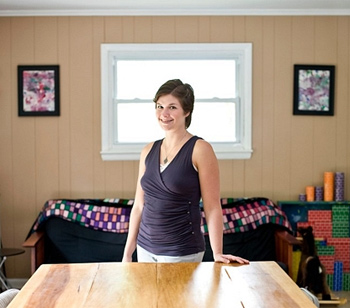
The Rev. Sarah Jobe is a chaplain at the Raleigh Correctional Center for Women and the site coordinator for Project TURN, which runs graduate-level theological classes through correctional centers in central North Carolina.
In the early 2000s, Jobe moved into the Rutba House, an intentional Christian community comprising two houses in Durham, N.C. She continues to live there today, now with nine adults and four children, including her husband and children.
“Over the past seven or eight years that I’ve lived there, we have heard from our neighbors about the needs of the community, and we’ve tried to let those articulations shape the types of work we choose and the initiatives we pursue,” said Jobe, whose first book, “Creating with God: The Holy Confusing Blessedness of Pregnancy,” will be released in October.
Jobe describes below how she came to the Rutba House, what it’s like to live in the community, how it has influenced her work, and how she practices hospitality.
It was Thanksgiving Day about 10 years ago. A friend and I were making the short drive from Durham to Chapel Hill, headed toward the first of two meals. There was no one on the street, except for a man sitting in the median, holding up a sign. He was hungry and homeless. I had seen him many times before. I told my friend, “We should be inviting him to come eat with us.” My friend said, “I know, but you know that these people we’re going to eat with will flip out.”
She was right. So we went on our way, but we agreed, “If in two hours, when we’re driving back, this guy is still here, we’re going to stop and invite him to the second dinner.”
On our trip back, he wasn’t there. I was heartbroken. It’s heartbreaking to know that you haven’t done what God has asked you to do. That was a real turning point for me. I told myself that day, “I have to right now make my life hospitable.”
Questions to consider
Questions to consider:
- What communities do you know that practice the kind of hospitality Sarah Jobe describes?What are the ways in which your own institution shares its time, space and other resources with the surrounding community?
- What would it take for your institution to live out the radical hospitality described in Acts? What kind of design would make this activity sustainable?
- Witnessing difficulties in the neighborhood inspired Rutba House to design an after-school program and a re-entry program for women. How might difficult experiences become tools for innovation in your own leadership?
- Making life hospitable for Jobe meant living where she might legitimately meet a stranger. What border-crossing experiences might help cultivate your imagination and ministry?
That meant living among people who were not like me, surrounding myself with people who wouldn’t flip out if I invited a homeless man to dinner, and proactively welcoming strangers. That’s what Jesus asks us to do -- to put ourselves where we might legitimately meet a stranger, who is anybody we don’t know.
Within a year, I had moved into the Rutba House, an intentional Christian community. There are actually two houses that make up this community, and our core values are discipleship of peacemaking and hospitality. We’re here learning to be good neighbors, and that shapes our life together.
We pray together every morning, we give portions of our income to a common purse, we hold weekly potlucks, we open our home to people in need, and we have an open-door policy to kids in the neighborhood. We do this because it seems like this -- the sharing of life and of resources -- was what was happening in the book of Acts when the Holy Spirit was freshly at work.
We have made pretty deep friendships, especially with kids in the neighborhood. But as we have done so, we have watched boys, right around the time they move into middle school, drop off one by one, falling into gang activity and drug activity and violence. It’s incredibly painful to watch.
That was the motivation to start a small after-school program. So once boys in our neighborhood get to around the fifth grade, we pair them with a mentor who is willing to help them with homework but also with life skills. We expanded the program to girls this year.
In one particular case, there is a young man who is a really, really dear friend and whom the kids in the neighborhood know well. I watched him go in and out of prison. A few months ago he was shot in the chest four times. He will probably be paralyzed from the waist down -- if not the neck down -- for the rest of his life.
What has come out of that experience is a grieving of his lack of options. It’s very sad to see guys come out of prison and not be able to get jobs; and if you can’t get a job, you essentially can’t meet your own needs. I’ve seen guys faithfully hold on for months, piecing together their life -- piecing together food, a place to stay, housing, clothing -- but you can’t piece those things together for long.
That young man who was in out and of prison -- I don’t want to see that happen ever again.
He is our motivation for continuing with our after-school program and for the work that we’ve now been doing with re-entry. One of the women who lives in the Rutba community has started collaborating on a restorative justice project that works between family members of folks on death row and family members of murder victims. And this fall we’re opening a re-entry house in the neighborhood for women being released from the correctional center. A married couple from Duke Divinity School will also live there.
The idea is that the students and women leaving prison will experience Christian friendship and support one another as housemates, blurring the social and class divisions that incarceration creates.
Yes, it can be scary to practice hospitality. A big reason why I moved into the Rutba House before I married was because I was afraid to practice it alone. Even after I got married and we decided to continue to live in Rutba, there is still the fear of giving up stuff -- the fear of sharing your living space, time, bathroom, basic needs.
I can remember times when I have started to feel like I was suffocating. “Oh my goodness,” I have thought, “This is too much; my space is getting too small.” I don’t know if I have intentionally gotten over that fear, but when those moments sneak up again, I think about when my husband and I got to the point where we were the ones in need.
See, a few years ago, my husband lost his job and I was pregnant with our second child. It was very scary. I had already cut back on my work, and we were depending on his income. But we never worried about losing our home; we never worried about going without food; we never worried about our children not having what they needed. Why? Because we, by the grace of God, had a community around us.
So when I feel cramped living with a bunch of other people, I try to remember how life-giving it is to share our space with other people who could support us when times were tight. And I remember that I didn’t come to this house because I felt some special calling; I came because I was trying to take the Bible seriously. And I have found that our lives feel more faithful when we have an openness to welcoming people into our homes.
-- As told to Cherry Crayton


