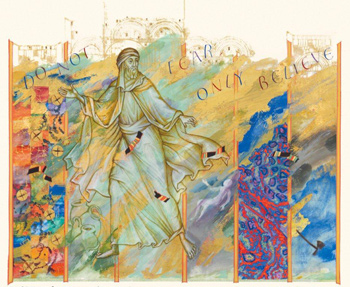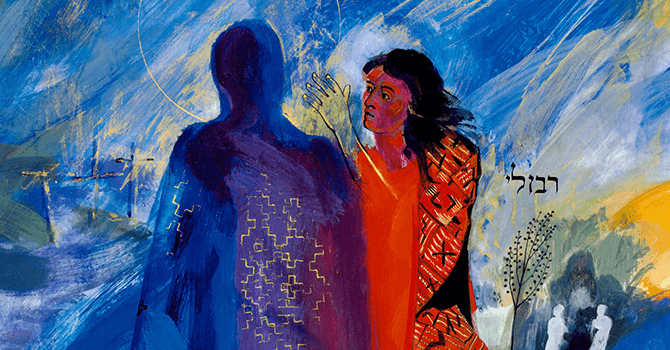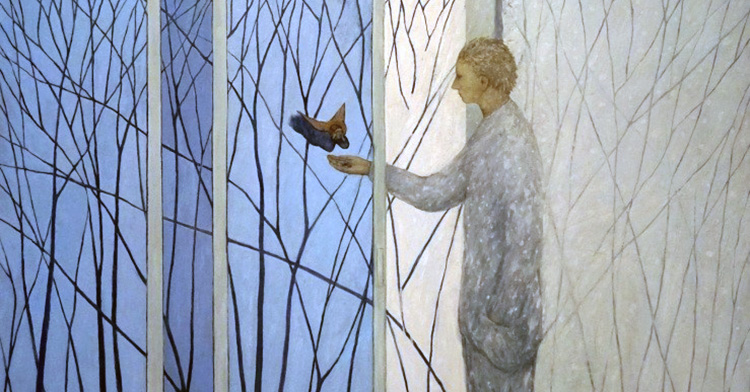
It’s impossible not to be mesmerized by the meticulous craftsmanship of The Saint John’s Bible: exquisite calligraphy done with hand-cut quills, stencils and stamps of gold powder, and pages made of calfskin gilded with gold leaf.
But it’s not an art book, insist the people who are working with it. It’s an interpretation of the Bible that incorporates ancient craft with modern-day worship, and its theological relevance goes far beyond its appearance.
“The art leads to the theology and the theology leads to the art,” said the Rev. Michael Patella, chairman of the Committee on Illumination and Text -- the primary group that determined the Bible’s contents -- and a professor at the School of Theology-Seminary at Saint John’s University, which is about 90 miles northwest of Minneapolis. “We wanted the two of them to work in tandem.”
The Bible is the culmination of 30 years of dreaming by Donald Jackson, a British calligrapher who expressed interest in making a handcrafted Bible as early as 1970. The process began in 1995, when he broached the idea with the Hill Museum & Manuscript Library at Saint John’s University. The school spent two years pondering the proposal, including creating test pages and doing preliminary planning of possible illuminations. In 1998, the university and Jackson signed a contract for the $4 million project, which involved scholars in Minnesota and a team of artists coordinated by Jackson in Wales.
On Ash Wednesday 2000, Jackson wrote the first words, from the Gospel of John: “In the beginning was the Word, and the Word was with God, and the Word was God.”
The effect transcends denominations. Although The Saint John’s Bible is a Roman Catholic interpretation, Wilson Yates, a retired professor of religion and the arts at United Theological Seminary of the Twin Cities, is unabashed in his reverence for it.
Questions to consider
Questions to consider:
- To what do we pay attention? What draws our attention to every detail? How can the things on which we focus shape our imaginations?
- How can we account for awe? As we are able to draw attention to the stunningly beautiful elements in Scripture, how can we breathe deeply and let the beauty envelop us?
- Imagination is cultivated by border crossings. The Saint John’s Bible crosses the borders between centuries of technology while maintaining a firm footing in the tradition. When and with whom do we explore boundaries of time, culture and relationship? What might we do to create and sustain a discipline of border crossings?
- Saint John’s organized pastor groups studying the illuminated Bible. What other ancient and contemporary works might be the focus of reflection for groups of pastors? Music? Buildings? Paintings?
“The text and the visual imagery work together in a way that is more profound in its impact than either the text or the imagery is on its own,” he said. “It’s all about the power of the combination of the two art forms, literary and visual. It’s a book for any Christian reader -- or non-Christian, for that matter,” he said.
That opinion was seconded by one of Yates’ associates, Cindi Beth Johnson, the seminary’s director of community programming in the arts, religion and spirituality.
“The images alone in The Saint John’s Bible could stand as a theological proclamation,” she said. “The Bible invites people to see the Scripture in a new way because of the images.”
The experience of God in the 21st century
One of the many things about Jackson’s proposal that intrigued the university was its timing, Patella said. A new millennium was approaching, and the school saw the Bible as a way of commemorating that. When Jackson mentioned that he had pondered the same thing, “at that moment, everything seemed to fall together.”
Patella’s Committee on Illumination and Text determined four main categories that it wanted the book to emphasize.
The first was biblical exegesis. The second was biblical cross-reference, he said. “As a way of informing the artists, we’d tell them if, say, a piece of text in the New Testament was borrowed or repeated from the Old Testament.”
The third category was local association. The committee tried to work in as many references to Saint John’s University and Minnesota as possible.
“The reasoning behind that was to give the reader a historic sense of where the manuscript came from,” he said. “If you look at the Bibles from 500 years ago, for instance, they have illustrations of the Cathedral of Notre Dame.”
The fourth category was called “free association” and was considered the most important.
“We encouraged people to reflect on a passage and share anything that it brought to mind,” he said. “For instance, the story of the loaves and fishes. Perhaps someone would look at that and say, ‘It reminds me of when my dad took me fishing.’ And someone else would say, ‘It made me remember my mother baking bread in the kitchen and all the wonderful smells that created.’”
Any avenue that could be used to engage the reader was explored.
“The idea was to show how Scripture is integrated into our lives in ways we might not even realize,” he said. “You don’t have to be a New Testament scholar or an expert in the history of early Christianity. The Bible offers a very rich array of reference and discussion points.”
Although employing production techniques from the 18th and 19th centuries, The Saint John’s Bible was created for reading in the 21st century.
“Those Bibles depicted the Earth as the center of the universe,” he said. “Our understanding of science has changed a lot since then. Or take globalization. Yes, those Bibles were written for a global world, but their concept of the world was much smaller than ours. We used the same mindset, just a lot bigger.”
He said the committee also wanted to take a broad cultural perspective.
“For one thing, we wanted to make sure we noted what women have brought to history,” he said. “And we wanted to focus on the downtrodden and the marginalized, the people who were ignored in the illuminated Bibles of the past. If you look at those Bibles, you see pictures of kings. We wanted ours to be more democratic.”
The committee members realized that every decision they made about the Bible “was a theological one. How we completed this Bible would express to us and to the rest of the world, both now and in the future, how we respond to our Christian faith’s experience of God at this point in time,” he said.
Allowing for the ‘awe factor’
The art and text don’t always work simultaneously. Sometimes they end up taking turns, and that’s perfectly understandable, said Barbara Sutton, an associate dean at Saint John’s School of Theology-Seminary.
It was her job to develop curricula to accompany the Bible. She was quick to realize that the textual interpretation was not going to be the top thing on most people’s minds the first time they encountered the book.
“We had to allow for the awe factor,” she said. That meant being patient while people were entranced with the artistry. But it also meant being confident that the Bible eventually would come to be appreciated for its entirety. She never doubted that moment would arrive for everyone who studies the book at length.
“Pope John said that the church was not called to be a museum but rather a living flower garden,” she said. “The same thing applies to The Saint John’s Bible. It was not made just to sit in a museum. It needs to be the living word of God.”
Sutton also works with the Sustaining Pastoral Excellence (SPE) program, an initiative of Lilly Endowment Inc. that gave grants to more than 60 organizations around the country, many for pastoral peer groups. As a part of the program, Saint John’s University started pastor groups and pastor retreats organized around and drawn directly from The Saint John’s Bible. Sutton is excited about the way the Bible has come to play a part in that endeavor.
“It is igniting the pastoral imagination,” she said. “It is leading people to hear the word of God anew.”
Sutton drew up a series of study guides to accompany the Bible. The material was intended for seminary students, but she has been flooded with requests from neighborhood parishes wanting copies.
Although most SPE programs are designed primarily for clergy, she’s glad to share the information with anyone who is interested.
“They want advice on how to integrate the illuminated text into the parish system,” she said. “And that means that the parishes want to build a sense of community around the Bible, which is a strong point of concern for SPE.
“And now we’re getting calls from hospital chaplains. I was surprised by that, but I guess that I shouldn’t be, because [the material] is so full of healing Scripture. The reflection guide for the section on Lazarus being raised from the dead is very popular with chaplains, although everyone seems to have their favorite.”
Full-size reproductions of the Bible cost $130,000, putting them out of the reach of neighborhood churches. But smaller, mass-produced copies are available at a wide range of prices, from about $500 per volume on the high end to $400 for a complete set of seven.
Sutton relishes discovering that The Saint John’s Bible is being used in ways she didn’t anticipate. “There are a lot of lenses for it to come through,” she said.
Using the arts to engage readers
The artwork is so intricate that people can spend hours studying a single illumination.
“Sometimes they’ll choose a particular illumination and reflect on it,” Sutton said. “It’s part of lectio divina. You take what’s in your mind and move it to your heart. That’s the real transformation. That’s when you move forward in God’s word.”
A copy of the Bible is on display at Saint John’s University in its Hill Museum & Manuscript Library. Even though touring exhibitions of the book continue to crisscross the country, the Hill Museum attracts a steady stream of visitors who have come to see it.
“It has become an evangelistic tool,” Sutton said. “People come from all over to look at it. When you walk into that museum and you see the illuminated text, it hugs you right to it. It makes you want to say, ‘Where have you been my whole life?’”
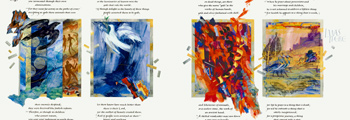
The book is immense. It consists of seven volumes measuring 2 feet by 3 feet when opened. Each two-page spread is considered a single entity, with the layout designed by computer so that multiple pages could be worked on simultaneously without the craftsmen worrying about where page breaks in the text would fall.
The calfskin used for the pages was soaked in lime, dried and then sanded by hand until nearly translucent. The black ink was ground from 19th-century Chinese ink sticks, while the colored ink was made from pigments mixed with egg yolk and water. The body text was written with goose quills; turkey and swan quills were used for larger fonts. The gold leaf was applied using the moisture of the artisan’s breath blown through a bamboo tube.
The artwork varies in size, sometimes simply running down the side of a page or across the top of a two-page folio. But other illuminations fill an entire page. The one that opens the book of Psalms, for instance, incorporates references to the monks at Saint John’s Abbey, Native Americans, a Jewish men’s chorus, Buddhists, Muslims, Taoists, Hindus and Indian Sufis.
Patella jokes that sometimes he thinks the students in his classes are paying attention to the Bible for the first time. He has seen an entire classroom of teenagers look up from their laptop computers and put down their notebooks when he shows them one of the Bible’s illuminations.
“Maybe I’m looking at this as a 56-year-old guy, but it seems to me that many of the young people don’t read anymore,” he said. “They’re visually oriented, from their videos to the icons in their computer games. Most of them need to be visually prompted, and this Bible is doing that.”
He can see the difference in their reactions. If he has them read a page out of a regular Bible, they lose focus. But if he shows them artwork from The Saint John’s Bible, he has their rapt attention.
“They will start asking questions about the text,” he said. “Their interest in the image causes them to be interested in the text.”
It’s not just college students who see the text in a new light, he said. The “awe factor” that Sutton noticed also can serve to re-energize anyone’s reading of the Bible.
“I think a lot of people have gotten to the point that they read the Bible as if it’s a lab report,” Sutton said. “By that I mean that they are detached. What this Bible does is use the arts to make it more engaging.
“Sure, you’ve seen the word of God before, and you’ve heard the word before,” she said. “But never like this. This is like seeing it for the first time.”