
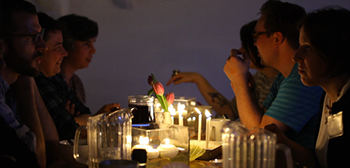
Volunteer cooks arrive at the Brooklyn Zen Center around 6 p.m. on Sunday nights. A chalkboard sign, the kind that might advertise a restaurant’s nightly specials, pops up on the sidewalk. As guests show up, they’re given a name tag, newcomers are introduced to the regulars, and all are invited to chop vegetables, set tables or fill water pitchers.
Around 7 p.m., someone strikes a gong and announces, “Come and gather around the candle!” The crowd of about 30 comes together, a volunteer taps out a rhythm on an African drum, and a song leader begins singing “Jesus, We Are Gathered.”
This is not a spirituality meet-up taking Christianity for a test drive. It’s not family-night supper for hipsters. This is church.
It’s St. Lydia’s, a church at once ancient and new, a self-styled “dinner church,” where worship, drawing on early Christian practices, takes place around a full, sit-down meal.
The church began in 2008, when Emily Scott, then director of worship at Riverside Church in Manhattan, realized that many young New Yorkers wanted to connect with a church but couldn’t “get their foot in the door.”
“I started to think, ‘There’s a hunger; there’s a need that’s not being met,’” she said. “What would a church for these people look like?”
Scott credits the Holy Spirit for the answer to that question.
“The idea of a church that was centered around the early church practice of having a meal together as Eucharist just kind of fell out of the sky,” she said. “It felt like it arrived fully formed.”
Establishing a congregation and shepherding its growth, however, has been an ongoing process, one that upends some traditional ideas about emerging churches and embodies apparent contradictions.
St. Lydia’s is a church grounded in both early Christian practice and modern urban living. It’s named after the woman in the book of Acts known for her hospitality and located in a city where hospitality can be a rare and radical act. The services are informal and welcoming, but they follow a structured and thoughtfully constructed liturgy.
Unlike some emerging churches, St. Lydia’s -- though founded as an independent church plant -- has deliberately chosen to affiliate with a mainline denomination, the Evangelical Lutheran Church in America, and is also in partnership with another, the Episcopal Church. Rather than embrace a non-hierarchical structure, it cultivates and develops leaders within the congregation and is going through a discernment process to create a governance structure. Yet it also allows for a certain fluidity in leadership and encourages even first-time attendees to participate.
When Scott started St. Lydia’s, she was “in this weird denominational no man’s land.” Raised Episcopalian, she earned degrees from Yale Divinity School and the school’s Institute of Sacred Music, but she wasn’t ordained. (She’s now a candidate for ordination in the ELCA.)
Core principles
At the core of St. Lydia’s life together is a set of principles that Scott developed at the very beginning, before the congregation ever met: “Telling Our Story. Sharing the Meal. Working Together.”
The “story,” Scott said, is both the gospel story and the story of God at work in congregants’ lives. The “meal” is the Eucharist. And “working together” conveys an almost monastic vision of work and community life, virtually as a form of prayer. And it all adds up to a church grounded in community and hospitality.
Questions to consider
Questions to consider:
- How can your congregation gather around a table for a weekly meal? How would it affect the group's spiritual and physical life?
- How does your church or other community ensure that “everyone has a place at the table”?
- In what ways are countercultural acts -- like a home-cooked meal in NYC -- vital to the life of a church?
- Where is your church or institution on the continuum between freedom and structure? How well does it navigate those tensions?
- St. Lydia’s is “at once ancient and new.” What qualities of leadership allow for such traditioned innovation?
To young people who live in New York City, where kitchen space, home-cooked meals and dining room tables are hard to come by, those principles have great appeal.
“We live in an age where people interact through screens a lot, or eat standing up,” Scott said. “What we’re doing is sitting down and looking at each other, which is pretty countercultural.”
As informal and welcoming as the service feels, Scott, who trained as a liturgist and musician, has created a well-ordered service. The meal begins with a eucharistic prayer taken from the Didache, a second-century instruction book for Christians. Though not ordained, Scott is licensed to preside over communion at St. Lydia’s.
As Scott chants the prayer, she breaks fresh bread, passes it to the circle of congregants and invites them each, in turn, to take the bread, break it again and offer it to another with the words, “This is my body.”
Unlike in traditional liturgy, the blessing of the cup comes much later, at the end of the service.
“We’re blessing the entire meal as sacred and as a meal at which Christ is present in the bread and the wine and all the food, and in all of us,” Scott said. “We are Christ to one another at that meal. I often imagine that we’re all sitting around the table and that Christ is there, too.”
‘St. Lydia’s is reverent’
That sense of the sacred appealed to Phil Fox Rose, who visited other churches before he found a home at St. Lydia’s about a year ago.
“A lot of nondenominational and emergent stuff has an overtly irreverent, unstructured, even anti-church vibe,” he said. “St. Lydia’s is reverent.”
In keeping with the rules of the Zen Center, where St. Lydia’s rents space, the church uses grape juice, not wine, and requires all who come to remove their shoes at the door.
After the breaking of the bread, the congregation shares a simple vegetarian meal, such as rice or pasta with vegetables. Then Scott leads a Scripture reading and preaches a short sermon, after which people are invited to respond, drawing on their own experiences.
Following a song, prayers and the blessing of the cup, one of Scott’s favorite moments in the service begins, one in which the formed community becomes fully visible -- cleanup. Everyone joins in, washing and putting away the dishes, and then the service concludes with an offering, singing, the passing of the peace and a final blessing.
“It’s like jazz improvisation,” Scott said. “We create the structure -- it doesn’t change -- and then people can kind of riff on it.”
Mabel Bermejo, a Catholic who has come to St. Lydia’s for about a year and a half, appreciates the participatory service.
“It’s not passive; it’s very active,” she said. “It’s not like you’re sitting on a back pew. Everyone has a place at the table.”
Rachel Pollak, St. Lydia’s part-time community coordinator and only salaried employee, helps people find their place in the church, encouraging them to take a turn as deacon, lead cook, sous chef or song leader.
“I have a kind of ‘mother hen’ personality at church, because sometimes people need to be pushed and prodded to break free of inhibitions and habits of isolation that keep us from connecting,” she said.
An artist with both an M.F.A. and a degree from Yale Divinity School, Pollak also oversees St. Lydia’s garden, leads Bible study, and works out the rotating schedules.
Freedom and structure
“People feel free when they have a role,” Pollak said. “That’s part of what we do at St. Lydia’s. We give people a role to play, a structure to be free in.”
Navigating the tensions between freedom and structure is part of life at St. Lydia’s, perhaps nowhere more so than in its relationship to denominations. In its founding, the church was as entrepreneurial as it gets, with Scott and a group of friends basically starting it on their own, with no help or guidance from the institutional church. But as St. Lydia’s grew, members began to see benefits in being part of a denomination.
After meeting initially in congregants’ apartments in Manhattan, the church met for almost two years at Trinity Lower East Side, a Lutheran church. That arrangement proved critical for St. Lydia’s, giving the church both distance and support.
“To innovate, you need to find some creative and supportive distance from an institutional structure,” Scott said. “It’s not a negative distance; it’s a supportive distance. The ELCA knew about us and cared about us and were giving us time and space to do our thing. As we’ve grown, we’ve developed the relationship.”
In fall 2010, the congregation, under Scott’s guidance, began considering whether to become part of the ELCA. They met with denominational officials and considered what it meant to be Lutheran. Some congregants questioned the value of joining the “sinking ship” of mainline Protestantism, but in discussions and sermons, Scott explained that “you can’t be a Christian alone; we can’t follow Jesus in isolation.”
After nine months of discernment, St. Lydia’s decided in July 2011 to affiliate with the ELCA, initially as a “synodically authorized worshipping community” -- sort of a “get acquainted” trial status. This fall, St. Lydia’s officially became an ELCA “congregation under development,” which means it’s a church plant that the denomination helps support. This year, the ELCA contributes about 22 percent of St. Lydia’s budget. In 2013, Scott expects they will contribute about 43 percent of the church’s projected budget of less than $100,000.
‘A big step’
Connection to a denomination was a big step for St. Lydia’s, Scott said, one that will encourage accountability and help ensure that the church will thrive even in difficult times.
“Being affiliated is the most important thing I can do for the health of this community,” she said. “We will experience conflict and transition, like any community does. When that happens, the community is going to need a structure to help them through it.”
About a year ago, the church moved to Brooklyn, where most of the congregants live, meeting briefly at an Episcopal church before moving to its current rental space at the Zen Center.
On its website, the church proudly claims ties to both the Lutheran and Episcopal traditions, and, along with its ELCA affiliation, partners with and receives support from the Episcopal Diocese of Long Island.
The multiple ties are not surprising, since the two denominations are in full communion. Both the Rev. Jack Horner, the Metropolitan New York Synod’s assistant for evangelical mission, and the Rev. Canon John Betit, of the Episcopal diocese, said they have grown closer as they’ve worked with St. Lydia’s.
“We shouldn’t all be holed up in our silos,” Betit said. “We’re all in the same business.”
From the beginning, Scott has always been a tentmaker, or bivocational pastor, at St. Lydia’s, giving her services to the church and supporting herself with other employment. From 2007 to 2009, she worked full time at Riverside Church, and currently she works part time as director of family music ministries at the First Presbyterian Church of New York.
But this fall, for the first time, Scott will receive some compensation from St. Lydia’s -- a housing allowance in exchange for 20 hours a week.
As Scott looks back at all that has happened since that first burst of inspiration that “just kind of fell out of the sky,” she is grateful for the friends, colleagues, bishops and pastors -- the “great cloud of witnesses” -- who advised, supported and prayed for St. Lydia’s.
“Our congregation knows that we did this from scratch,” she said. “That builds a lot of ownership for them in what we’ve done together.”
Currently, the congregation is developing a governance structure, using a process of prayer, discussion and the sharing of personal experience. However that turns out, Scott likens her role to that of a bread-maker, who nurtures the bread so it will rise.
“I see the congregation as this kind of breathing entity that I’m in a relationship with, and it’s my job to shepherd and lead that congregation.”
By the very nature of worship at St. Lydia’s, the church is somewhat limited in how it can grow and must look for creative options. Hosting larger and larger groups for dinner would change worship considerably, so Scott instead plans for the church to grow “laterally.”
When weekly attendance reaches 35 or 40, she envisions adding services, possibly a Sunday brunch or a midweek dinner.
“I think if we have four services a week, we can be a self-sustaining congregation,” she said, though she wouldn’t lead every service. Eventually, she envisions the church having its own space, and possibly creating an intentional community for homeless youth, as well as hiring artists to work part time, like Pollack, so they can pursue their art.
As the church has grown, Scott said, she often thinks of the biblical story of the road to Emmaus. When Jesus broke the bread, the disciples realized who he was.
“We place practice before belief,” she said. “God’s always going to be bigger than what we write down, but just keep coming back to the table. That’s going to keep forming you.”