

What makes a community thrive?
As Christian leaders, we tend to assume we already know what thriving communities are; we then simply go looking for instances in Scripture that confirm our knowledge and agenda. Over time, we cease learning from Scripture how to think and instead use it as a tool to back up our cherished beliefs.
But the scriptural texts are not inert matter, words on the page simply waiting for verbal activation, or “ideas” asking for our intellectual assent. Scripture, so Christians confess, has the ability to effect change in the reader for the sake of the kingdom of God, to exert directive pressure upon our thinking by means of a fundamental transformation of life.
Indeed, the possibility for transformation is finally why we continue to return to the Bible: again and again, we sense that our resources, taken alone, are not enough for the magnitude of the task, that we need more than a new set of tools, or a different theory under which to conceptualize our work. What we need in order to create and nurture communities that thrive as foretastes of the kingdom of God is a kind of deep and abiding direction. Inasmuch as it actively orders and reorders our thought -- continually tutors us in how to think -- Scripture’s pressure is this deep and abiding direction from God.
The Acts of the Apostles is a particularly rich scriptural source for the kinds of questions we need to ask. Acts is the only biblical text that narrates the formation of early Christian communities in their earliest days. It corresponds, therefore, to the theological shape of God’s work in establishing communities that were meant to thrive. Acts offers us six features of a pattern of life in thriving communities -- not a “to do” list but a picture of what the church needs to continue being the church. To put it like this is to emphasize the fact that we cannot pick or choose which of the six features we like: according to the narrative of Acts, all six have to be there for the church to be the church (which is but another way of saying that the narrative of Acts is close to unimaginable without all six features).
1) Networks and networking
Some Christians do not like the thought of networking. To them it feels disingenuous, and they worry, often rightly, about a kind of schmoozing that is in bad taste. But socially embarrassing or morally questionable schmoozing is hardly what we see in Acts, and there is no better name for the activity of the early Christians in establishing relationships between the churches than networking.
Networking as a feature of early Christian existence emerges most clearly in the mission to the Gentiles. If one reads Acts while consulting a detailed map of the Mediterranean world in the first century, it is easy to see that the predominant strategy of the first Christians was to build their communities in major urban centers where the resources were plentiful: personnel, main roads, letter carriers, boats, travelers, trade and so on. Caesarea, Tyre, Sidon, Ephesus, Corinth, Philippi, Thessalonica -- these and many others were all ports or cities that lay along major roads in the Roman Empire. The early Christians used the advantages of such places to develop communities that could have easy contact with one another and could become, by means of their communication and interconnection, “brothers and sisters” in Christ. The distinctive Christian familial language, that is, has the social reality of networking as its presupposition.
Reading Acts carefully will disclose a remarkable level of interconnection between the various Christian communities in terms of both personnel and communication by letter and/or messenger. The Jerusalem council assumes its letter will reach the Christian communities scattered around the rim of the Mediterranean. And tracing Paul’s travel through his various journeys is an exercise in visiting and revisiting churches in virtually all parts east of Rome. In this way, the narrative of Acts helps to make concrete and intelligible the numerous greetings and personal instructions we see, for example, in Paul’s letters. According to Acts, the early Christians were fully networked.
2) Visibility
One of the most powerful and, in a sense, most pernicious dichotomies in the modern West is the public/private split. The effect of this dichotomy has been to privatize religion. One’s religion is not, for example, supposed to interfere in politics or play a part in a secular university classroom, or a public school. Christianity is what one does or says in a “personal” sphere, in private.
The Acts of the Apostles knows nothing of this dichotomy, and were Luke (the author of Acts) to have learned of it, he would have rejected it. In Acts, being Christian is by its very nature a public confession and identity. In fact, the very word “Christian” (Christianos in Greek and Christianus in Latin) is a public word. Contrary to what we might normally think, “Christian” was not first used as an internal self-designation. It was instead a term coined by outsiders, by those who could see a thriving community and needed a word with which to describe them (see Acts 11:26 and 26:28; also 1 Peter 4:16). To be a “Christian” was to belong to a group whose life was publicly visible.
One of the more obvious and important ways Acts evinces the public nature of the thriving community of early Christians is through Luke’s consistent portrayal of the Christian community as a force for cultural destabilization in the wider Mediterranean world. In Philippi, Athens, Corinth and Ephesus, the Christian presence is disrupting enough that the Christians are hauled before the authorities and forced to give account for their behavior.
Finally, the theological language in Acts for the fact that being Christian is not a private matter is “witness.” “Witness” and its cognates occur about three dozen times in Acts. This language points ultimately to the fact that thriving Christian communities in Acts are not self-existent in either their cause (they do not replicate themselves or their own mission in the world, but God’s) or their telos (their aim is not survival or even necessarily success in a directly tangible way). They exist as a witness to something beyond them. In a very deep sense, this means that thriving according to Acts entails a turn away from the self, the internally focused vision that so many communities have and in which they remain caught.
3) Provision for the weak
One of the potential difficulties in describing something as “thriving” is that it can evoke images that have to do with health, strength, vitality, independence, flourishing and so on, to the explicit exclusion of weakness, sickness and dependence. But to read Acts well is to realize that we would be deeply mistaken if we were to think of thriving solely in terms of the strong. In Acts, thriving includes provision for and inclusion of the weak and the downtrodden -- not as a kind of “add-on” to the central mission of the church but as something integral and internal to its identity.
Indeed, the first real communal problem in the church -- a threat to its thriving -- occurs when the so-called Hellenists (Greek speakers) complain against the Hebrews (Aramaic speakers) because the Hebrews are neglecting the Greek-speaking widows in the daily distribution of provisions. Acts devotes only a few sentences to this controversy (see 6:1-6), but we know it seriously threatened the church because all 12 apostles appear on the scene, and they, in turn, summon the other leaders and develop an authority structure (deacons). By developing a lasting structure to deal with the potential rupture in the church, Acts displays what becomes a central feature of the thinking of the church’s leaders: they look beyond the need to “fix” a problem (of which there are several in Acts) and instead think about thriving in a much longer-term perspective. That such a long-term, structurally focused perspective is powerfully depicted in relation to the provision for the weak should be no surprise to the reader of Acts: as Acts says explicitly in its depiction of Christian life in 2:41-47 and 4:32-37, provision for all is fundamental to the thriving of the early Christian communities.
4) Processing of disagreement/conflict
If we asked enough people, we would doubtless discover a tendency to think that disagreement and conflict are incompatible with thriving. The simple reason for the prevalence of this thought is that it is at least somewhat true: a community cannot have ongoing, irate, throat-clenching fighting and thrive. But as a whole and in a deeper sense, thriving does not exclude disagreement/conflict. Instead, to thrive is to be able to incorporate conflict and disagreement into the life of the community.
There are many instances in which the author of Acts narrates the incorporation of conflict into the life of the community, but none as well-known as the Jerusalem Council in Acts 15, considered by many historians to be the first great church council. The issue at stake in that council was whether or not Gentiles had to be circumcised to be saved (and by extension, therefore, whether they had to keep the Jewish law to effect salvation by Jesus). At this remove, it can be difficult for us to appreciate how important an issue this was to the early Christians, but it was the first real tectonic theological issue in the emerging church, threatening its unity at the core (think of Paul’s vehemence in his letter to the Galatians, for example).
There are three indispensable elements to the way in which the passage shows the processing of disagreement/conflict; together they constitute a paradigmatic instance of the working of “traditioned innovation.” First, there is the experience of the Spirit (Peter, then Paul and Barnabas). Second, there is the agreement of the Spirit’s work with Scripture (James’ citation of Amos). Third, there is a structure of ecclesial authority (James and the apostles have a kind of definitive weight in the final decision). Yet such elements are not given in a stepwise fashion, as if a community could always progress from the experience of the Spirit to the decision of the leaders. These three elements are instead indispensable parts of one complex and total picture. Precisely because Acts tells the story of the Jerusalem council by means of an interplay between them, we can conclude that all three are constitutive of the ability to incorporate deep conflict. The intertwining of the powerful work of the Holy Spirit, the prefiguring and confirming role of Scripture, and the discerning work of the community’s leaders suggests, further, that where communities sacrifice one of these elements for the sake of any of the others, they will not be able to incorporate well the conflict and disagreement that will inevitably come in their life together.
5) Articulacy of belief
One does not have to read long in the book of Acts before encountering what becomes a major narrative device throughout the story: speeches. There are multiple speeches peppered throughout Acts (Peter, Stephen, Paul, James and so on). The prevalence of speeches in Acts points to the basic importance of what we may call the articulacy of belief: the ability to say what it is that forms the core of the thriving community’s existence.
In our day it is all too easy to equate articulacy with intellectual sophistication. But according to Acts, this equation would be a mistake. In Acts 4 Peter and John are taken before the Jewish authorities and asked by what name they have healed the lame man by the Beautiful Gate (Acts 3). Peter replies to their request with a short sermon. The authorities, says Acts, are stunned at the power of the sermon, because Peter and John are “uneducated, common men” (RSV). The Greek here literally says “illiterate idiots” (agrammatoi kai idiōtai). In Acts, to be articulate is not necessarily to be sophisticated; it is quite simply to be able to say what is the ultimate reason for the community’s existence (by what name it lives).
Knowing the ultimate reason for a community’s existence, however, is not automatic, a given, something that magically appears in one’s head upon joining. Much to the contrary, it has to be taught and transmitted. The necessity to teach the community’s raison d’être is nowhere seen more clearly than in the first and paradigmatic episodes in Acts (chapters 2 and 4). Upon joining the church, we are told, the new converts devoted themselves to the doctrinal instruction (didachē) of the apostles. The new Christians learned, therefore, what the new life was that they had embraced, what it meant to be Christian. Here, as with the processing of disagreement in Acts 15, we can see traditioned innovation at work in bringing to life and sustaining a thriving community.
In the view of Acts, then, a thriving community is one that knows why it exists at all -- the content of its being as a community -- and is able to articulate to others this reason for its existence. Furthermore, it has developed ways of teaching this articulacy to the new people who join the community so that there is a transmission of and continuity in community identity and mission. It would not be too strong to say that without this transmission and continuity in identity, the community has no chance whatsoever to thrive in the long run.
6) Suffering
Once again, Acts confronts us with the necessity to expand the normal notions associated with “thriving.” Typically, we would not associate suffering with thriving. If people are suffering, so our common sense would tell us, thriving is not the best word to describe their condition.
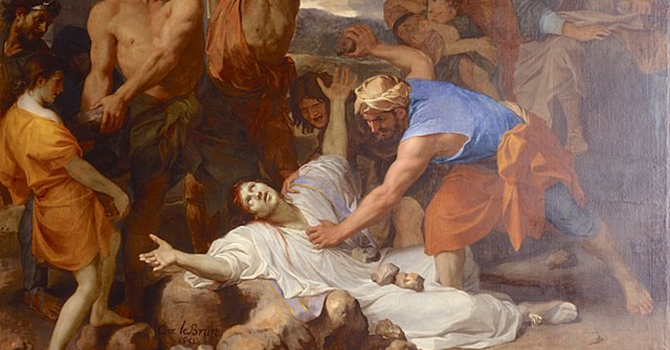
By stark contrast, to observe thriving communities in Acts is to see that they suffer almost from start to finish. This is true not only of the chief characters Peter and Paul -- think of Stephen, the first Christian martyr -- but also of the particular Christian communities scattered throughout the Mediterranean basin. In addition to overt stories that mention Christians who were in trouble or danger because of their faith (Jason in Thessalonica or Alexander in Ephesus, for example), we find remarks that simply presuppose suffering as a part of the life of Christian communities. For example, after Paul and Barnabas preached in Derbe, Luke tells us that they returned to Lystra, Iconium and Pisidian Antioch, “strengthening the souls of the disciples, exhorting them to continue in the faith, and saying that it is through much suffering that we will enter the kingdom of God” (14:22).
To take suffering seriously as part of the pattern of a thriving community is simultaneously to see clearly that there is a sense in which thriving Christian communities consistently run the risk of being an offense to the world, a problematic thorn in its side. Acts would instruct us, that is, to be suspicious of our tendency to think that if we develop thriving communities we will be liked, be rewarded for our work, appear attractive and exciting -- or to suppose that because our community is thriving people will want to join it en masse or come to work with or for us. Learning from Acts requires us to learn that to thrive in a Christian sense is also to provoke, to remind the world of both its brokenness and its hope.
In conclusion, to learn from Acts how to think about thriving communities requires us to nurture an imagination that tries to think about a total pattern of life. The six features identified above are not individual guarantors of a thriving community but are different strands of a unified community life whose interweaving constitutes a particular way of being in the world.
This is part of a series. Learn more about the concept of Thriving Communities »