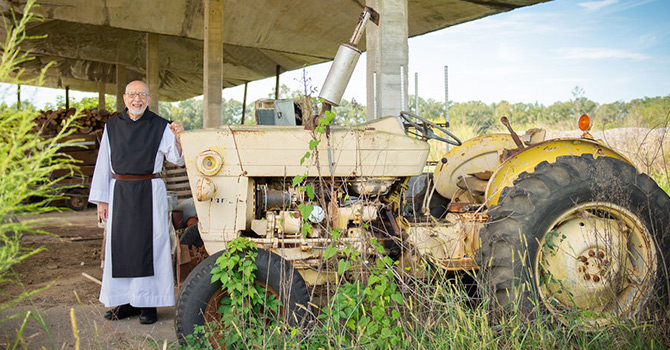

It’s 7:30 a.m. and I’m standing in the choir of the church at Mepkin Abbey, a Trappist monastery near Charleston, S.C. The priest lifts the bread and wine and asks God to “make them be for us the body and blood of Christ.”
I sing the Lord’s Prayer in halting Gregorian chant. Give us this day our daily bread. My prayer is answered when I line up with the monks to receive Christ’s body and blood. We eat. Then the monks file out the door, on to morning duties, on to earning their daily bread.
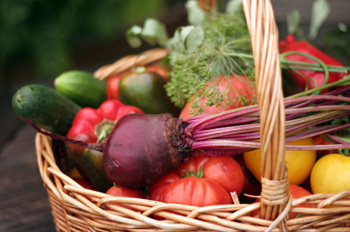
I follow Father Guerric, who is in charge of all things agricultural at the abbey, into the garden. Some monks work in the vegetable garden, where they grow collards, pole beans, broccoli and lettuce. Most work in the oyster mushroom operation, which, aside from donations, is the monastery’s main source of income. After chatting with Father Guerric I poke around the monastery gardens and think back to the morning Mass.
Thanksgiving is upon us, a time when “giving thanks” can easily become, even in Christian households, a rote exercise one performs over the turkey and stuffing, a necessary cultural artifact one gets out of the way and doesn’t repeat until the following year. Of course we give thanks at Thanksgiving, whether the thanks is meant or not.
But as I wander the monastery gardens I find myself thinking not about the feast days but of ferial repasts. These are the everyday meals which, without a rich sacramental life to accompany them, become bleak affairs signifying nothing more than the intake of nutrients.
What was the connection between those consecrated elements and the pumpernickel I ate for breakfast or the oyster mushroom risotto I had at lunch? Perhaps our sacramental bread is less a representation of our daily bread than something that actually gives shape and meaning and coherence to it. Eucharistia, in Greek, means thankfulness.
Is there a relationship between the ritual of Eucharist and the amount of appreciation we’re able to muster when we offer God thanks for our food?
And, given that most of the food we eat comes to us via the industrial food system and thus is grown in a matter that could be hard to describe as holy, could it be that we have impoverished food lives precisely because we have impoverished sacramental lives? Looking at the growing movement in the church to reconnect with that most fundamental part of life -- food -- my answer is yes.
Whether we sit before a simple bowl of soup or a groaning board of turkey and fixings, this moment before we eat is our chance to make the event more than just a herd of animals around a feed trough. Food is not merely fuel or cultural expression. It is the daily sacrament by which we affirm our creatureliness and our utter dependence upon God.
In his book “For the Life of the World,” Orthodox theologian Alexander Schmemann says, “Centuries of secularism have failed to transform eating into something strictly utilitarian. Food is still treated with reverence. A meal is still a rite -- the last ‘natural sacrament’ of family and friendship, of life that is more than ‘eating’ and ‘drinking.’ To eat is still something more than to maintain bodily functions. People may not understand what that ‘something more’ is, but they nonetheless desire to celebrate it. They are still hungry and thirsty for sacramental life.”
I came to Mepkin Abbey with such a hunger and thirst, and I was not disappointed. I left with the conviction that a life steeped in liturgy and sacrament can make us appreciate what we mostly take for granted: food, shelter, the clothes on our back, a community to support us.
If, as I fear, we face a future of climate disruption, economic crises and a collapsing food system, the need for places like Mepkin takes on practical considerations as well. Father Guerric is modest about his efforts, as the monastery has only recently started focusing on sustainable agriculture. But he sees great possibility for this place to become a model for sustainable Christian communities. He also sees hope in a growing movement in the church helping people reconnect with the sources of their food, and most importantly to see the link between our daily bread and the Bread of Life.
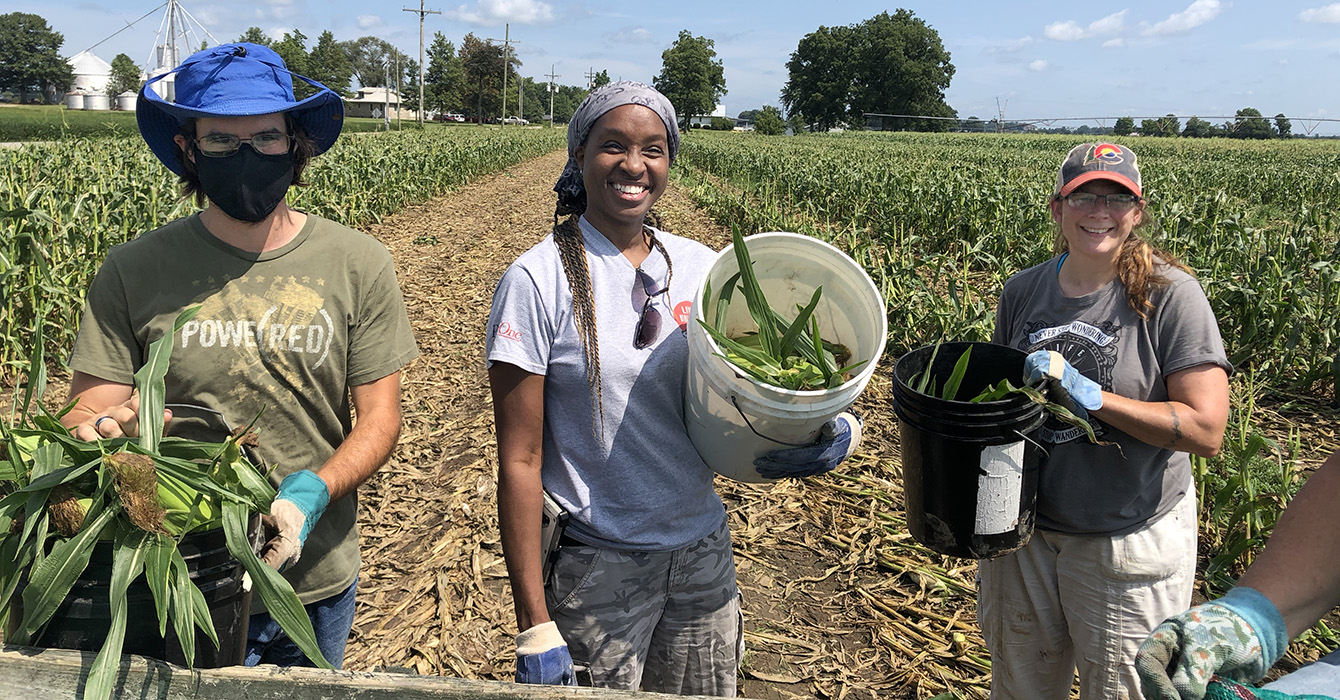
During the four years I directed a church-supported community garden ministry we would often hold Eucharist in the garden on our Saturday workdays. I came to learn what was confirmed at Mepkin: that the sacrament of Christ’s body and blood doesn’t end at the communion table. It spreads outward into the streets and fields, the creeks and rivers, the gardens and mushroom buildings, the Thanksgiving feasts and the monks’ Spartan tables and back again to the lifted elements. Had we the “conviction of things not seen” we would recognize this seamless flow of nutrients both visible and invisible, profane and holy. And we would be changed.
A final memory of my visit: On my last morning at the abbey, I take a walk in the woods and discover a pile of discarded mushroom spawn, or starter. Growing out of this refuse are several pounds worth of beautiful oyster mushrooms. I take them for what they are: a surprise gift, undeserved, requiring nothing more than to be eaten in gratitude.