

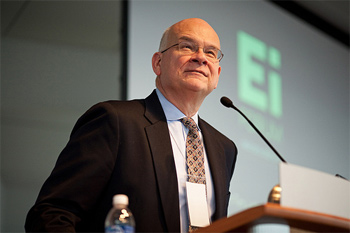
“God is an entrepreneur.”
I’d have cringed at those words once, as would many academics and pastors. But I recently had the opportunity to hear the Rev. Tim Keller’s presentation on that theme at Redeemer Presbyterian Church’s Entrepreneurship Initiative Forum. It left me convinced of the truth of those words.
Keller has a kind of sneaky, unpretentious brilliance about him, which largely accounts for his church’s growth from a church plant in a living room in 1989 to 5,000 Manhattanite members now and 2,000 more in church plants around greater New York. Media accounts of Keller, even sympathetic ones, misrepresent his gifts by describing him as professorial. But professors are hardly, as a class, given to filling auditoriums with volunteers. Keller’s charisma has more to do with wisdom, humor and profundity.
These attributes were on display as Keller addressed an audience at the fifth of Redeemer’s annual gatherings for investors and entrepreneurs who are part of what Redeemer calls a “movement of innovative, gospel-centered, culture-renewing institutions and ventures.” Participants are gifted in starting and sustaining businesses, nonprofits and art ventures, and speakers included financiers, politicians and business wonks.
But Keller was clearly the megastar, and theology the chief topic of interest. He defused the tension deftly after his long walk to the podium.
“The applause stopped before I got up here,” he said. “That’s never good.”
Entrepreneurs, he argued, are creators. And if they are to create as the triune God creates, they should do so informed by the story of God’s creation, the human fall and divine future redemption. In his address, Keller argued his audience into new, more beautiful ways of viewing the world. I found this four-part schema to be elegant, biblical, expansive and potentially life-changing.
First, he said, creators working in God’s image do not do so to achieve something: power or status or success. That was why the builders of the Tower of Babel created. No, it is simply good to bring order out of chaos. That is reason enough to create: “God didn’t have any reason to create. We do so because we’re reflecting our creator.”
Keller contrasted the biblical creation narrative with that of other ancient cultures. In most stories, the world comes about as a result of violence between gods. Similarly, modern naturalistic accounts portray the world’s deepest nature as one of arbitrariness and violence. But the biblical God has no rivals who could make him fight. God wasn’t forced to create, nor did God do so by accident.
Second, those who create like God do so for the sake of others. The triune God has an orientation directed toward others, first among the divine Persons, and then among the others whom God created. God wants these created others to enjoy and love him as the divine Persons, Father, Son and Spirit, eternally do. God creates so others will have space and share his goods. And human creators should do as well.
Those who create like God, third, do so in full knowledge of the risk and the cost. God was not surprised by humanity’s fall in Genesis. And God knew full well that he would take flesh and go to hell to bring about the salvation of his sisters and brothers. So, too, human entrepreneurs create knowing there will be risk, and in imitation of a God for whom that risk was infinite.
Keller’s fourth point was that Christians know that, despite this risk and cost, creating will have been worth it. “God didn’t just perform one great act of entrepreneurship.” There was a second one, described in 2 Corinthians 5:17-19: “God was in Christ reconciling the world to himself.” To create a new humanity of reconciled sisters and brothers in his Son, God was willing to create anew. So, too, do Christian entrepreneurs create in full knowledge of the difficulties, and in full confidence that the reward will be worth it.
And here, Keller said, Christian entrepreneurs have a leg up on secular social entrepreneurship. For Christians, even if a venture fails, it will not be forgotten by God.
The church as entrepreneur
In some ways, the most impressive entrepreneurial initiative at the Forum was Redeemer itself.
In the world of church plants it’s relatively old, dating from the late 1980s. But in terms of the church on the North American scene, it’s almost unheard of: a growing evangelical church in the heart of one of America’s most secular cities. Keller sees Redeemer’s work as an effort to show his fellow evangelicals that the city is no place to be feared. Sure, it’s full of conflicting perspectives on faith and all manner of other things, and it presents opportunities to fall far from one’s faith. It also presents opportunities to fall more deeply in love with Jesus. And it offers what evangelicals have to love most: opportunities for evangelism.
“Georgia and South Carolina have 16 million people in them. New York City has 18 million,” Keller has written. “Now where has your denomination concentrated more of its efforts?”
Many successful church planting stories trade on having a founding pastor with manic networking skills. Church growth Keller-style is quite different.
One can see the fruits at Hunter College on the Upper East Side: several thousand people pile into the auditorium seats, eager for a half-hour sermon stripped of light shows, movie clips or entertainment of any sort. There’s just Keller, a small music stand and rapt attention.
There’s also an emphasis on beauty. Keller was influenced by the unlikely trio of Jonathan Edwards, C.S. Lewis, and Flannery O’Connor. The 18th-century American revivalist, the 20th-century British apologist, and the early 20th-century Catholic Southern Gothic writer all share an emphasis on the beauty of God.
For Keller, Jesus is not just a psychological salve to fill a hole in an empty heart. Jesus is beautiful. All people should want to contemplate God’s beauty forever. Aesthetics is a very old theme in Christian theology with new popularity in the academy -- but it’s not one often sounded by evangelicals.
“Happiness is the life-shaping certainty of something you don’t have yet,” Keller preached.
One can see this emphasis on aesthetics clearly in any worship service. At an early service on the Upper West Side, sans Keller (he preaches at Hunter), the Rev. Abraham Cho, an assistant pastor, prays to the “God of radiant joy.” As he introduces the prayer of confession he says his listeners are “enthralled by the beauty of things that are good, but not ultimate.”
This emphasis on goods and God is almost dogmatic at Redeemer. It inspired Keller’s recent book, “Counterfeit Gods.” The money, power and status that New Yorkers seek are not evil (as Redeemer’s fundamentalist forebears would have said). They’re good. They’re just not God. As pointers to God they can be enjoyed, but worshipped in God’s stead they enslave.
“They’re signposts,” Keller said, drawing on his hero Lewis. “Silver and gold signs that point the way for the pilgrim to get to Jerusalem.”
Combining goods and God is a central focus, too, at the Entrepreneurship Forum, where you can see Keller’s other genius: an ability to gather like-minded others, and not just those who won the church’s annual business plan competition or whom the Forum has invited to speak.
Participants include representatives from Rising Tide Capital, a micro-credit and business training initiative in Jersey City, N.J., founded by an Ethiopian native and one of her Harvard University classmates in 2004. The organization has been recognized by President Obama.
I also met a young man who sells crepes out of a stand in Flint, Mich. “It’s surprising,” he said. “I have a proper job running a landscaping company. If anything, you’d think that was entrepreneurial. But it’s this crepe-selling thing that I get media attention for.” He paused and reflected. “It’s weird, so it gets noticed. It makes you think about how the gospel has to be weird to get noticed.”
Weird. Noticeable. Like a passionate evangelical church in Manhattan, a nonprofit that caught the president’s attention and a crepe seller. Like a professorial gospel preacher to day traders and homeless people. Like an entrepreneurial God.