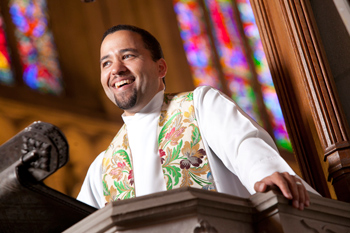

Editor's Note: This sermon was preached May 21, 2007, at the Thriving Rural Communities Aldersgate Gathering at Duke Divinity School.
“Can anything good come out of Nazareth? . . .
‘Come and see.’”
Jesus finds Philip, so then Philip goes and finds Nathaniel to tell Nathaniel that he has found Jesus, forgetting exactly who found whom in the first place.
(We do that sometimes.)
“Nathaniel,” Philip says, “we’ve found him, we’ve found the one, the one about whom Moses and the prophets wrote, the Savior, and, are you ready for this, it’s Jesus, son of Joseph from . . . Nazareth.”
And Nathaniel looks at Philip as if Philip has just told him that really, the Chicago Cubs are really, actually going to win the World Series this year.
“Nazareth? Can anything good come out of Nazareth, much less the Savior of the world?”
“Can anything good come out of Nazareth?”
I did some reading about Nazareth. It didn’t take long, because we don’t know much at all about Nazareth in Jesus’ day. Nazareth is barely, if ever, mentioned in first century documents outside of Scripture. The little we do know is largely speculative and wholly unremarkable. Apparently scholarship suggests that Nazareth was a small community of anywhere between 500 and 2000 people: likely just about the size to qualify for funding from the Duke Endowment’s Rural Church Division. Nazareth was likely located not far from a major East-West trade route that ran from Egypt to Asia called the Via Maris: picture it as one of the small communities you see exit signs for off that major trade route from East to West that we call I-40. Specifically, Nazareth was situated in the hill country of Galilee, a region of fishing and farming that was also known in Scripture for its distinctive regional accent and for having a large population of Gentiles, a high number of immigrants, foreigners, resident aliens.
Archaeological evidence also shows that Nazareth may have sat somewhat in the shadow of the nearby city of Sepphoris, which was being rebuilt as a regional capital around the time of Jesus. Sepphoris was the place where the action was. Sepphoris was the place with the multiplex cinema- or at least Roman theater. Sepphoris was the place where the young people went off to work and find jobs. Nazareth . . . well, apparently nothing much happens around Nazareth. Nothing to make the news. They apparently don’t even have a sign on the edge of town that says, “Welcome to Nazareth, home of . . .” and then the name of some small-time celebrity or state champion high school basketball team.
Even the HarperCollins Bible Dictionary describes Nazareth as, quote, “an insignificant agricultural village.” Of course, it would probably say the same thing about Brown Summit, where I grew up, and about most of the rural communities represented in the Thriving Rural Communities program.
So when Philip says we’ve found the Messiah and he’s from . . . well, the insignificant agricultural village of Nazareth, Nathaniel can only say, “Can anything good come out of Nazareth?”
Maybe Nathaniel said that not only because of Nazareth’s seeming insignificance, but maybe Nazareth also had something of a reputation. After all, Jesus didn’t always have the easiest time in Nazareth. Mark says that Jesus could do few healings in Nazareth, because of the residents’ unbelief and lack of faith. Matthew suggests the people of Nazareth won’t listen to Jesus because they still just think of him as the carpenter’s son, Mary’s boy. Or we think back for a minute to Jesus’ first sermon in front of the home folks, that we read about in Luke 4. Remember how Jesus returns to the synagogue in Nazareth to preach homecoming, and he stands up to read and chooses the scroll from the prophet Isaiah, “The Spirit of the Lord is upon me, for he has anointed me to preach good news to the poor. He has sent me to proclaim release to the captives and recovery of sight to the blind, the let the oppressed go free, the proclaim the year of the Lord’s favor.” And then Jesus sits down to teach, and tells them, “Today, now, this Scripture has been fulfilled in your hearing: here, in Nazareth.”
At first everybody is proud of him, amazed at his gracious words. They pat each other on the back and say to themselves, “Get a load of Joseph’s kid; maybe something good’s going to come out of Nazareth after all for a change.”
But Jesus’ homecoming sermon doesn’t go too well after that: it’s amazing how much things can change in the course of one sermon. Jesus knows his people so well that he knows what message they most need to hear, and he loves them so much he is willing to preach it. He’s said he was anointed to release captives and open the eyes of the blind, so that is what he will do.
Jesus is aware that the people of Nazareth are clamoring for him do the same kind of healings and miraculous cures there as he has done elsewhere. And they probably think that since Jesus is from Nazareth, and that they are his own people, that they’ll receive preferential treatment: after all, they’re from Israel, and believe they are more important than those Gentiles living across the border.
“Doubtless you will quote to me the proverb, ‘Physician, cure thyself,” Jesus says. (Not a bad proverb in reference to the clergy health initiative, by the way: ‘Physician, cure thyself.’ “Minister to the body of Christ, minister to thy body.”). But what Jesus is referring to is the fact that the people of Nazareth believe Jesus the physician should heal his own people first: them. But Jesus opens the eyes of their blind provincialism and tries to set them free from their captivity to racism by reminding them that God’s love extends beyond them, that it was to an immigrant widow whom God sent Elijah, and not a widow in Israel, and that out of all of the lepers in Israel, Elisha only cleansed the foreigner Naaman.
At which point the congregation offers to take Jesus cliff diving without the water to soften the landing.
Those of us who’ve grown up in Nazareth know that it has its challenges. We’ve seen some of the violence that simmers beneath the surface of civility, the willingness the draw hard lines between insider and outsider, the family identities that can crush true expression of self, the thinly veiled prejudice propped up with a Proverb. Jesus has had to rescue some of us from that. And it’s not the last time a congregation in a rural community would try to run a preacher out of town who dared to preach the truth of God’s word.
Hearing those stories about Nazareth, you can understand why maybe Nathaniel might have heard enough about the village to ask skeptically, “Can anything good come out of Nazareth?”
And yet the amazing thing is, Nathaniel is about to discover that something beautifully, wonderfully, salvifically good did out of Nazareth. Jesus came out of Nazareth. It was in Nazareth that Jesus was raised. It was in Nazareth that he likely attended synagogue and recited Torah and learned the words of Scripture. It was in Nazareth that Scripture says Jesus “increased in wisdom and in stature and in divine and human favor.” And as Lawrence Wood reminds us, all the rest of his life, Jesus would carry the name of his home community with him: on the lips of crowds, demons, and angels, he would be called, Jesus of Nazareth.
There is a sense in which the greatest gift the world has ever received, Jesus, was the gift of a rural community.
The Thriving Rural Communities Initiative has, at its heart, God’s love for Nazareth, and for those rural communities that Nazareth is a symbol of. It is an initiative that believes that those communities still have great gifts to give to the world and to the church.
For some people, Nazareth and communities like it are just exits on the highway, undeveloped land, the boondocks, pretty pastorals on the way to somewhere else, or even just a field ed placement or a first appointment.
But God loves Nazareth. As it is. And as it will be. And God cares about the suffering of Nazareth.
Nazareth and the rural communities it represents have gone through a time of great change and suffering over the past 60 years. When I was a pre-medical student, I learned that whenever a baby or small child fails to grow or mature in the proper way, a doctor formally diagnoses the condition as “Failure to Thrive.” Usually the condition happens because of bad eating habits, a lack of economic resources, poor parenting practices, emotional stress, or the presence of a genetic defect.
Many rural communities and churches have failed to thrive for some or all of the above reasons. Rural Communities have been the ones who have borne the changes of industrialized agriculture, and as family farms have disappeared, rural communities have suffered for our insatiable appetite for cheap and highly processed food. Bad eating habits. Rural Communities and small towns have born much of the brunt of globalization’s impact, as mills have closed, jobs have been lost, and the textile industry has all but disappeared in North Carolina. Rural school systems, with their smaller local tax base, often have less funding available for schools than their urban and suburban counterparts. Lack of economic resources. Rural Communities have been at the front-lines of the difficult issue of how to welcome the sojourner or foreigner in our midst. Rural counties have struggled with plagues of poverty and hunger; and many in rural areas have tried to address their spiritual emptiness with methamphetamine instead of Methodism. Rural leaders, including rural church leaders, have often lacked courage or proved ill-equipped in facing these challenges in a visionary way. Lack of resources, emotional stresses, innate problems, poor parenting. And a recent newspaper article showed that a disproportionate number of the military casualties and human cost of the wars in Iraq and Afghanistan have been borne by the people of rural America.
God loves and cares for these communities, and calls upon Christ’s church to respond to these challenges creative and faithful ways, so that they can thrive in the abundant life of Christ, and be what they were created to be.
And yet for all of the current struggles, and for all of the real challenges facing our churches in rural areas today, Thriving Rural Communities also believes Nazareth, as it once did, still has great gifts to give the world: gifts of genuine human community, true appreciation for the Creation, a rich storehouse of practical skills and wisdom, a beautiful image of what Christ’s church can be.
Nazareth can still offer Christ to the world.
Nathaniel asked Philip, “Can anything good come out of Nazareth?”
And do you remember what Philip said? “Come and see.”
To a world and a church that wonders, sometimes skeptically, sometimes hopefully, “Can anything good come out of Nazareth?,” we hope to say, “Come and see.”
I believe that the church of Christ is meant to be a preview of the future, a kind of prequel to the kingdom of God, that shows people now what the heavenly life will be like when Christ’s new world comes. We are a kind of visual aid for the kingdom, because people have to see it before they can believe it, and they have to believe it before they can be it.
It is my hope that God will use Thriving Rural Communities to be a preview of renewal in the rural church. I hope that the pastors and students and churches who are a part of this initiative will allow people to see a new future, and seeing that future, to believe in it, and believing in that future, to one day be that future, by the grace of God.
Can anything good come out of Nazareth? “Come and see.”
Come and see Solid Rock and Sandy Plains and Cedar Grove. Come and see Friendship and Hayesville and Tyro and Fairview. Come and see Disciple Bible Studies’ Prison outreach, where the captives are set free and prison staff are ministered to. Come and see Courage to Serve, where pastors draw upon their communion with each other to lead others to communion with Christ. Come and see students whose lives have been changed by their ministries with country people. Come and see pastors who realize that rural churches are places where the risen Christ is transforming lives and where they can live out a deeply fulfilling vocation.
Come and see the gifts of rural areas.
Or, in those moments when you doubt that anything good can come out of rural communities, come to the cross, come and see there the sign above the head of the crucified Savior of the World, the sign that proclaims him the King of the Jews and be reminded that the sign begins, “Jesus OF NAZARETH . . .”
Thanks be to God. Amen.