
Editor’s note: Faith & Leadership offers sermons that shed light on issues of Christian leadership. This sermon was delivered on Yom Kipper in 2007 at Temple Micah in Glenside, Pa.
There’s an old saying -- still totally relevant today -- that the job of a clergyperson is to “comfort the afflicted and afflict the comfortable.”
Which is why I envied my old neighbor, Rev. Robert Jones, pastor of the Bethlehem Baptist Church. Those of you who are familiar with the history and the surroundings of Beth Or, where I served as rabbi from 1978 to 1986, might recall that Bethlehem Baptist is an African-American church that has been in Penllyn [Pa.] for decades. They bought the old Beth Or.
I spoke about Robert Jones in a sermon a few years ago. What I envied about him -- what I witnessed close-up -- was his leadership, his power, something that flows from the way his [congregation] is organized.
He’s the boss. ... Really, the boss!
Me? Back in the congregational days, there was a man whom I privately thought of as “the king of constructive criticism.” He never missed an opportunity to tell me how I could be a better rabbi -- how I could more effectively serve the congregation, and him personally.
One time I said to him, “Phil, I wish I had 10 congregants just like you.”
“Why’s that?” he asked.
I replied, “Because I have 20 congregants just like you.”
OK, it’s the holiday of truth telling. I never said that to him or to anybody else. But I sure did think it.
The contrast between the power exercised by Robert Jones and me reflects one of the sad realities of the American rabbinate: most congregational rabbis serve at the pleasure of their members, and anybody with a grudge can work himself or herself into a leadership position where he or she can threaten the rabbi’s very livelihood.
This effectively -- except for some rare, mega-secure and, most likely, independently wealthy rabbis -- puts an end to the idea of rabbi as a prophetic voice, the rabbi as a courageous voice who will assess the lives of a community and speak out powerfully when serious sins are detected.
Rabbis, for the most part, simply do not afflict the comfortable, because we cannot.
Here at Temple Micah there’s another dynamic operating. I’m fortunate that I don’t have the many constraints under which my colleagues work. But on the other hand, since we’re a high-holidays-only congregation, I’m not familiar with the details of many of your biographies, and you don’t really know me all that well either, although you do hear slices of my life now and again in my sermons.
So I can’t deliver a fiery message afflicting the comfortable, since I don’t know how comfortable you are and whether you need afflicting anyway. I can speak in generalities, of course, listing the failings of which every community is guilty. In fact, it’s a tradition on the holidays to do just that.
One of my favorite stories concerns the congregant who approached his rabbi just after the Days of Awe had ended.
“Rabbi,” he said, “I don’t quite understand it. Every year you preach about how people need to stop cheating and lying and gossiping and hurting one another and ignoring the poor. And yet each and every year, after the holidays end, people continue to cheat and lie and gossip and hurt one another and ignore the poor. So what’s the value of your sermons?”
The rabbi replied, “It’s so they don’t get worse.”
So here and there I’ll speak in such generalities, and, of course, throughout these services our liturgy offers more lengthy and more specific encouragement about recognizing and repairing our failings.
But the second part of that saying -- “comforting the afflicted” -- that, I can try to do. Because, though I don’t know each and every one of your life stories, and though you don’t know mine, we are all afflicted. We all endure triumphs, but also sadness; successes, but also defeat upon defeat as we make our way through our journey. That is, simply, life.
During my college and seminary years, I kept a short sentence pasted to my desk, where I could see it daily. I don’t know the author, but I recall how, back then as well as today, it speaks to me: “If we never bled, we’d know less well the red warmth of our living.”
How to address some of the sadness we all feel and the defeats we recognize, especially at the moment when our Jewish tradition calls upon us to evaluate our past and prepare for the future? What can one say -- what words can one use -- that will touch our hearts and our souls and give us strength?
Well, I found one piece of wisdom that’s helped me during the past 18 months, ever since I learned it. It’s petty succinct, which is important. It’s an insight I’d not previously seen or considered. I found it in a most unlikely place.
One expects rabbis to quote the Torah or the Talmud or Hasidic tales and to derive profound wisdom from those sources. But this time, it was neither Torah nor Talmud nor the Hasidic masters that provided me with this quote. It was a sign along the side of Route 202 in Blue Bell.
I was driving down that road toward Norristown in April 2006. On the right side I passed the office of an orthopedic surgeon who had a fairly large sign in the front on which he posts various messages and slogans. On this particular day, what caught my eye and quickly entered my heart were these simple words: “Everything’s never going to be all right.”
Try to remember that, will you? A pithy little sentence. A statement that’s really obvious, totally accurate and, frankly, something we just don’t think about most of the time. It’s something that had never really occurred to me -- which is why I put myself in some danger that day, driving while writing down the words on a scrap of paper.
Later I emailed the orthopedic surgeon thanking him for the inspiration and asking the source. He told me he heard it from one of his patients, a man from Central America. The surgeon thinks of that man fondly whenever those profound words re-enter his consciousness, which they often do, in so helpful a manner. “Everything’s never going to be all right.”
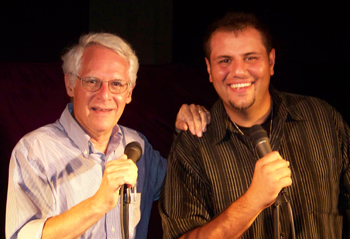
As both a speaker and a comedian, I’m acutely aware of the importance of the way spoken words are delivered -- of how the slightest change in emphasis can redefine a message or reveal a totally new insight.
Think of that phrase, “Everything’s never going to be all right.” Say it one way and it’s a lament of defeat, a resigned sigh that shuts off hope. “Everything’s never going to be all right.”
Nope, the future is a gloomy mist, and no matter what we do, no matter how hard we try, there’ll be no victory. We’ll never, ever climb all the way to the summit. Never.
Yet move the emphasis back one word and the meaning changes completely. “Everything’s never going to be all right.” Oh? Well, yes, of course. That makes sense. What was I thinking when I wished for some kind of perfection in my life and in our world? Of course, everything’s never going to be all right, so let’s just do our best and work most diligently and accomplish what we might and strengthen as many relationships as possible and heal as many hurts as we can and simply get on with this imperfect life.
The difference between the two interpretations? Resignation versus hope.
About 15 years ago, I heard comedian Allan Havey perform in Montreal. In the midst of his routine, he picked up a theme that, while funny, spoke to me then as now in a much more serious way. It was a riff on life and, more so, longing -- on the way we continuously look to the future for improvement. It’s an apt parallel to the concept of “Everything’s never going to be all right.” Only his mantra was, “Things will be better when …”
For example, Havey pointed out, “When you’re a toddler, you think, ‘When I get to nursery school, things will be better.’
“Then, in nursery school, you think, ‘Just as soon as I get into regular school, things will be better.’”
The projections continue. “In junior high school, it will be better.” “Just wait until I’m in high school.” “College will be better than this.” “When I’m married, things will be much better.” “After the kids are grown, that’s when it will be better.” “Retirement. That’s the key.”
And finally, Havey concluded, “When I can reach the toilet without soiling my pants, then things will be better.”
There was a big laugh from the young audience. Lots of applause and cheerful hooting. I stood in the back of the crowded room and thought, “This is not only comedy; it’s a sermon.”
Thoughts of dissatisfaction. Thoughts of “if only.” Thoughts of, “Wait until the future, and things will be so much better. Then things will be all right.” Thinking such thoughts, struggling with disappointment and wondering if some day everything will be all right is an eternal part of human nature.
A story from the tales of the Hasidim illustrates it well, and the teller, my colleague Rabbi Rami Shapiro, proposes a solution.
A Hasid once visited Rabbi Yaakov Yitzchak, who was known as the Chozeh, or “visionary,” of Lublin. The Hasid came to complain about “alien thoughts” that would invade his mind and make prayer impossible for him.
“And what thoughts trouble you?” the Chozeh asked.
The man then went on to catalog a great list of thoughts: His business was not as good as it could be. His customers owed him too much; his competitors were undermining his profits. His wife was not satisfied with their livelihood. His daughters needed dowries. His son was not the Talmid Chacham, the scholar, he had prayed for. And so on.
When the man finished, the Chozeh said, “Alien thoughts? My dear friend, these are not alien thoughts at all. Why, they are clearly thoughts that are quite at home in your mind.”
Now, this story -- like many Hasidic tales -- has an abrupt ending that’s rather obtuse. But Rabbi Shapiro takes over, lending meaning to this description of thoughts that haunt.
It’s something with which we’re all afflicted, Rabbi Shapiro explains, and these thoughts have one thing in common: they’re thoughts of dissatisfaction. Things simply aren’t the way we would want them to be. Alien thoughts, some may call them, but in reality, they’re not alien at all. Rather, they are our everyday musings.
What the Hasid in the story desires is to clear his mind of these thoughts -- something that is simply impossible to do.
There’s only one way to deal with these thoughts, Rabbi Shapiro tells us: let them be.
If you try to rid yourself of alien thoughts, you are only adding more dissatisfaction to your life, essentially setting yourself up for an additional unnecessary failure by attempting the impossible.
So what can you do? Follow the advice in Psalm 4: “Commune with your heart and be still.” To commune with your heart is to be present to the thoughts and feelings that arise. Notice them, but don’t engage them. This is what is meant by “be still.” Don’t move; don’t run after the thought to investigate it or change it. Simply note it and let it be.
By doing this -- by essentially acknowledging your negative thoughts -- you won’t get rid of them. The goal isn’t to get rid of anything, but to be present to everything.
What one discovers in stillness is not the end of such thoughts but the capacity to hold them without having them take hold of you. You are like the sky making room for clouds and yet not being attached to the cloudiness. And so we commune with our hearts in stillness. We recognize those alien thoughts. They are and always will be a part of our lives.
And besides, “If we never bled, we’d know less well the red warmth of our living.”
I said near the outset tonight that this would be a sermon that, I hope, comforts the afflicted. And “the afflicted” is all of us.
And we spoke about “alien thoughts,” the irksome, bothersome, depressing, saddening, maddening thoughts with which we deal, day in and day out. Thoughts of the illness and pain we suffer. That those we love and care for suffer. The plans unrealized. The goals unmet. The disappointments that cloud our vision and sap our energy.
And then for me, one day, while cruising down Route 202, a succinct piece of wisdom on a roadside sign lends a comforting perspective. Everything’s never going to be all right. Not “Everything’s never going to be all right.” But “ Everything’s never going to be all right.”
Our pain -- it’s there. Our disappointment -- it’s there. Our failure -- it’s there. All there. Which is why Rabbi Alvin Fine, in his evocative poem “Birth Is a Beginning,” speaks of how life is a journey, from stage to stage.
Rabbi Fine points out the different highs and lows in our daily living, and then observes, near the end:
From defeat to defeat to defeat
Until, looking backward or ahead,
We see that victory lies
Not at some high place along the way,
But in having made the journey, stage by stage,
A sacred pilgrimage.
From defeat to defeat to defeat. That’s just the way life is. And, well, “Everything’s never going to be all right.”
Abigail Thomas wrote a memoir about the months surrounding her husband’s death. She called it “A Three Dog Life.”
Tough times for her, a major transition, an uncertain and very different future. Out of her experience, Abigail Thomas drew wisdom and a helpful perspective for us, as we too contemplate our lives and think about what lies ahead.
She writes:
The future was also the place where the bad stuff waited in ambush. My children were embarking on their futures in fragile vessels, and I trembled. I wanted to remove obstacles, smooth their way, I wanted to change their childhoods. I needed to be right all the time, I wanted them to listen to me, learn from my mistakes, and save themselves a lot of grief.
But she ultimately realizes:
Well, now I know I can control my tongue, my temper, and my appetites, but that’s it. I have no effect on weather, traffic, or luck. I can’t make good things happen. I can’t keep anybody safe. I can’t influence the future and I can’t fix up the past.
What a relief.
For us, too: What a relief.
We know that “Everything’s never going to be all right.” We know that there is much we simply cannot expect ourselves to do, to control. We know there are things in the past that we can’t change or repair. We are burdened -- and sometimes overwhelmed -- with all kinds of alien thoughts of disappointment and failure. We need to simply let them be, to understand that they’ll always be with us and carry on as best we can.
It’s realistic. It’s helpful. It is, in some ways, even comforting to understand that “Everything’s never going to be all right.”
What a relief.