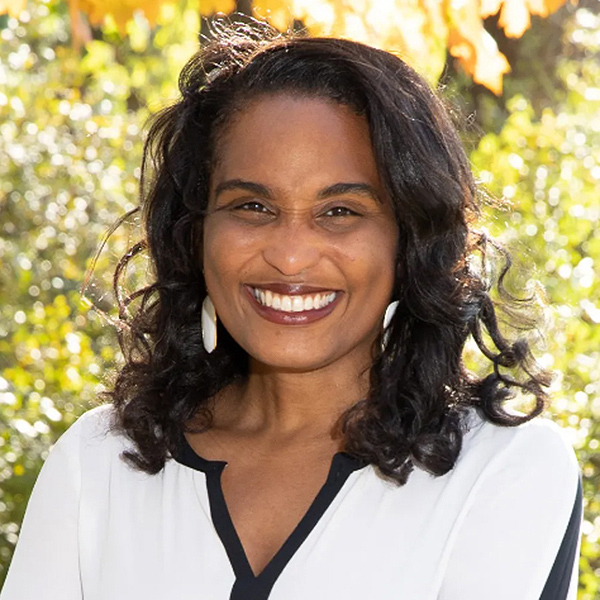
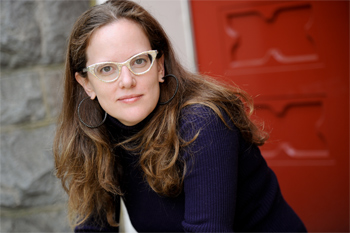
People often ask Duke Divinity Professor Lauren F. Winner how she can be so self-revealing in her books, which have chronicled the ups and downs of her faith life.
But talking about our lives with God -- good and bad -- shouldn’t seem so daring, she said.
“Not everyone wants to write a memoir or write a book about their anxiety. But should it seem shockingly self-disclosing to talk about how lonely you sometimes feel?” she said. “Not that the church needs to become an ongoing therapy session, but I do yearn for the church to be a place where people are able and encouraged and taught to talk about their relationship with God.”
In her first book, “Girl Meets God,” Winner shares her journey from Judaism to Christianity. Follow-up books include “Mudhouse Sabbath” and “Real Sex: The Naked Truth About Chastity.”
In her latest work, “Still: Notes on a Mid-Faith Crisis,” she writes about the period following the breakup of her marriage and her mother’s death, during which she experienced doubt and despair.
Now an ordained Episcopal priest, Winner is pondering not just personal issues but institutional ones, as well. She asks how church leaders can effectively reach out to individuals facing spiritual crises and what congregations could be doing to help Christians talk about their relationship with God in all its facets.
Winner completed doctoral work at Columbia and now serves as assistant professor of Christian spirituality at Duke Divinity School, where she earned a master of divinity degree.
Ordained as an Episcopal priest in December 2011, Winner spoke with Faith & Leadership about her new book and her new role in the church. The following is an edited transcript.
Q: In some ways your book “Still” is a book about failure -- of your marriage and then your sense of God’s presence. What do you hope people will take from your story?
C.S. Lewis said, “We read to know we’re not alone.” Those of us who are readers find a lot of our companionship, sense of solidarity and not-aloneness through books and through the communion of saints that we can meet in books.
For people who are hitting a wall in their spiritual life or who may feel very isolated, I hope that this book will provide a little companionship at the wall.
If, in addition, there’s an insight here or there that someone underlines and thinks is really helpful, that’s great. But if it offers some company to people when they hit their spiritual wall, that would please me.
Q: Do you feel that the act of writing the book was part of what moved you along spiritually?
There were some episodes or characteristics of what was for me a very spiritually difficult time that I understood more deeply through writing about them.
We don’t talk especially well in the church about people’s moments of spiritual desolation, and maybe there are Christians who don’t have those moments, but I think most of us have them.
It’s actually part of the architecture of the Christian life, not the odd exception.
The communities of which I have been a part are wonderful, nurturing, nourishing Christian communities, yet they do a better job talking about the beginnings of people’s spiritual lives.
We have a long history in North American Christianity of narrating people’s conversions as though that’s the end of the matter, when really that’s the prelude to the matter. And sometimes in our communities we say in response to someone’s spiritual desolation, “It’s fine; it’s understandable; we’ve all been there,” but we expect it to get resolved in about six weeks.
And if it doesn’t get resolved in about six weeks, the person must not be trying hard enough or something, or not doing the right kind of praying or something.
In some mainline communities, we may not talk very well about people’s encounters with God’s hiddenness because we don’t talk very well about people’s encounters with God, period.
Pastors are not the only people who have responsibilities in that area, but I think that it might be part of a pastoral office to think about, “Is your community able to talk about people’s lives with God?” If the pastor is not attending to that, it’s probably not going to happen by accident.
Q: What do you mean by that?
I’m an Episcopalian. It is very characteristic of many Episcopal churches that, for whatever reason, people are not all that comfortable talking about Jesus out in the world.
We might say, “I need to grow in comfort in publicly naming Jesus as part of my life.”
But how much of that are we doing even in our own church community? It’s not only at my job at the bank I’m not talking about Jesus. That’s something that we can keep deepening.
Q: In some ways, your life is integrated to allow you to do that -- maybe in a way that a bank teller doesn’t feel comfortable.
Right. But if the bank teller’s at a Bible study or has a friend over from church, can he or she talk even then about what is actually going on in that person’s spiritual life? If not, might we want to cultivate that practice more?
I am interested in the question of how churches can become places where people can speak about all of the corners and crevices of their spiritual lives.
I also sometimes find it a little alarming when people ask me, “What does it feel like to be so self-revealing? Now everyone who’s read this book knows all about your anxiety attacks and your intense loneliness.”
Not everyone wants to write a memoir or write a book about their anxiety. But should it seem shockingly self-disclosing to talk about how lonely you sometimes feel?
Not that the church needs to become an ongoing therapy session, but I do yearn for the church to be a place where people are able and encouraged and taught to talk about their relationship with God.
To the extent that churches do not encourage, teach and welcome people to do that, we are not fully living into our calling as the church.
Q: You were recently ordained. How has that affirmed your sense of vocation?
I was in the ordination process for about a decade, so I stretched it out longer than people usually do. I believe that there are some people who are called in a very specific way to ordination. It is what God wants them to do.
The sense I kept getting from God was, “If you want to be ordained, that’s great. I’ll roll with that. If you don’t, that’s fine, too. We can do something else together in the world for the kingdom.”
Yet I feel very much like the office of the priesthood is the office I am meant to be occupying in the church.
I recently read a wonderful formulation from the Orthodox Russian theologian Paul Evdokimov, who wrote that the priesthood of the laity is devoted to consecrating the world for God, making the world holy. And the priesthood of clergy is devoted to explicating that consecration through and in the sacraments, which makes an enormous amount of sense to me.
I was ordained into the priesthood last December. I was told by a wise priest in New Haven that she didn’t really know what it meant to be a priest until she’d been one for about a decade. I heard her say that and thought, “That seems right.” So ask me in nine years, and maybe I’ll have more to say.
Q : So you have three callings: priest, professor and writer. How do you see those three different roles and their relationship to each other?
In my life, they don’t feel like three distinct things. They feel like they are part of the same whole.
Now, that might be different if I were teaching in the math department, but everything I do feels like it’s in the same basket. So I don’t actually think I’ve ever experienced it as three distinct callings.
Q: What are the spiritual practices that sustain your faith?
Writing has long been a spiritual practice in my life. I feel like the way that I understand and apprehend anything, really, is through writing about it.
I think this is related to my sense of being called to the pulpit. Many of my most vital experiences come when I have somehow been exploring Scripture on the page, often for a sermon. So that’s an important piece of my spiritual practice.
Prayer has always been a backbone of my spiritual life, corporate prayer and often -- though not always -- individual prayer. I had some time when I really fell away from individual prayer. My prayer life is foundationally liturgical. It was when I was practicing Judaism; it is as an Episcopalian.
For the last couple of years, a major piece of my prayer life has been a method of prayer developed by Sybil MacBeth in a book called “Praying in Color,” which is essentially about praying via doodling.
This sounds absurd, but doodling prayer has been the only mode of praying I have experienced where an hour will go by and I will think five minutes have elapsed.
This particular mode of praying works for me because, A, I have no artistic talent, so there’s no voice in my head -- as sometimes happens when I’m writing -- saying, “Stop being present to the experience and make that tree look better.” I know the tree is never going to look better.
And B, every spiritual director I’ve ever had has tried to get me to have some part of my prayer life that doesn’t include words, because I’m so word-oriented. When I am praying in words, there is always a danger I’ll start thinking my way out of the prayer.
Q: What’s the value for you, aside from getting away from words?
For me, this practice underscores that one essential thing that we are doing in prayer, which is simply noticing that we are in God’s presence.
When my mother was ill -- she was ill for 15 months before she died -- at some point, it seemed that praying for her healing was not what I needed and wanted to be doing. But then I didn’t know what to pray.
So I said to my spiritual director, “What’s the right thing to be praying for?” and he said, “Maybe you should just picture your mother and picture Jesus showing up, and that is your prayer.”
That really changed dramatically what I thought about petitionary prayer. The heart of all petitionary prayer is drawing people into God’s presence. This mode of praying really holds that knowledge for me.
Q: You mentioned writing as a spiritual practice. What are your writing practices?
I’m a very undisciplined writer, unfortunately. I love revision. To me, the heart of revision is about seeing again what story I’m trying to tell.
So I have a set of revision exercises that are not designed to necessarily get me closer to the final draft but are designed to help me see the story differently. It may be something like rewriting a piece in a different tense and just seeing what you stumble over, what you notice and what you’re invited to see.
Beyond those kinds of things, I’m not really sure I can dignify much about my writing life with the phrase or term “practices.”
Q: In your latest book you say that “rote, unshowy behavior” is perhaps typical of the middle period of spiritual life. Why?
I think that it is perhaps a blessed reality that most of our spiritual life is not spent in ecstasy. For me, the most sustaining and sustained rote, unshowy behavior is just going to church.
I recognize that sometimes people have very good reasons for not going to church. Sometimes people have been really burned in a church situation and may need to remove themselves from institutional church life. But for me, the kind of routines and rhythms of the local church are bedrock in my spiritual life, and they’re terrifically rote and unshowy.
That’s the behavior that holds me to the Christian story and allows me to sometimes notice when God shows up. I don’t think that I would have the capacity to ever notice if I were not moored in the patterns and habits of communal life.