
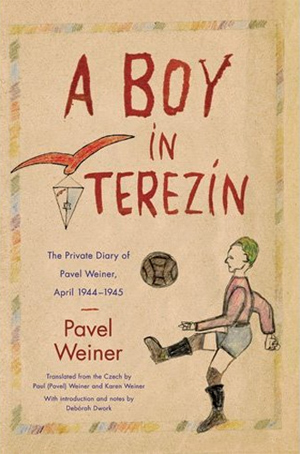
Karen Weiner heard little about her father’s Czechoslovakian boyhood until he came across the diary he had kept while living at Terezin, a camp for Jews operated by the Nazis during World War II.
“He didn’t find the diary until 1979, when we were moving his mother up from D.C. to New York,” Karen Weiner said. “By that time I was 10 or 11, and that’s when I really started to get a sense of what he had been through.”
 As a young adult, while studying history as a Duke University undergraduate, Karen Weiner traveled with her father four times to his hometown of Prague and to Terezin (called in German Theresienstadt). It was used by the Nazis as a propaganda tool, presented as a model Jewish city to help rebut growing accusations of mistreatment and genocide.
According to the introduction to “A Boy in Terezin,” about 141,000 Jews were sent to the camp; about 33,000 died from disease or the terrible conditions, and about 88,000 were deported to other camps.
The diary offers details of life at the camp -- including a boyhood filled with school schedules, sports practice and meals -- all set against the backdrop of the Holocaust.
“They played soccer and enjoyed concerts,” Karen Weiner said. “The way they created this life within total gloom and darkness is a real testament to the human spirit.”
With his wife’s typing assistance, Pavel Weiner worked on a translation of his diary into English for many years.
Meanwhile, Karen Weiner went on to pursue a master’s degree in education at Harvard University and has been a middle school social studies teacher in New York City for the past 17 years.
After her father’s death, the diary was published as “A Boy in Terezin: The Private Diary of Pavel Weiner.” Karen Weiner helped edit the book, which was published by Northwestern University Press, with an introduction by historian Deborah Dwork.
Karen Weiner spoke with Faith & Leadership about the process of telling her father’s story. The following is an edited transcript.
Q: What do you hope that people take away from this book?
Everyone can walk away from this with something.
I hope that it doesn’t just reach a Jewish audience. It’s really a universal story in so many ways.
I knew this was something I wanted to do for my father, but now that it’s published, I also want it to serve a purpose in society and be a story for people to take inspiration from. It’s a beautiful story of what people can do in the face of suffering and darkness.
I hope that they just take away a little boy’s story, in one aspect. Another thing I hope they take away is the Nazis’ sham. The question that comes up a lot in conversations is, “How much should we intervene in genocide or other conflicts around the world?”
When you hear about what’s going on in Syria recently or in Rwanda or the Balkans, you think, “How much should we be finding out, and what should we do with that knowledge?” That relates very much to this story.
I think also it’s about my father. He really wasn’t that interested in publishing at first. But as he saw himself and other Holocaust survivors getting older or sicker, he realized there will be no one around anymore to say, “This most definitely happened, and I can prove it.”
He realized he had something to leave behind, and that in itself was important.
Q: Your father seems like a real person in the diary -- a boy. He could be kind of obnoxious. He fights with his mother and his friends. Yet as a reader, you are aware of the terrible bigger story. What’s the significance of knowing that individual story within the bigger story?
I think that every story should be heard from the Holocaust, because each of them has something to teach us. And this one tells a slightly different story. He is a boy, and he’s creating this life for himself.
As his friends get deported out on these transports, he says, “I wonder if I’ll ever see them again?”
I know who he’ll see, and I know who he won’t. I found that very difficult. In my head, I’m thinking, “No, you won’t.”
The theme is constant fear of the transports -- not really knowing where they go, but knowing it was bad and would separate you from your family and your friends. To grow up with that fear must have been excruciatingly difficult.
Yet something very uplifting is the lengths to which the Jewish administration in the camp and the adults called madrichim, or counselors, went to make life somewhat normal for the boys and girls. It’s an incredible testament to human spirit.
The year he happened to pick to write his diary was significant. Terezin was the one camp that was shown to the outside world. He accidentally documented the complete sham that the Nazis ran in exposing Terezin to the Red Cross. That’s fascinating in its insight into how the Nazis duped the world -- how the world agreed to be duped, in a sense.
All the Red Cross had to do was open a different door, in a sense, and they would’ve seen a whole different scene. It makes you wonder how things could have played out differently, or how much is the outside world responsible for not intervening.
Q: So did your father stay in touch later in life with people that he knew in the camp?
Yes, it’s like a family. Building L417 [where Pavel lived] was a home for Czech boys, and the rooms were called heims, which means “home.” A heim was a room of about 40 boys. There was movement through them, because as people got deported out, new boys came in. I don’t know how many passed through that room in total, but about 10 of them survived.
Two of those remained in Czechoslovakia until their deaths and did not stay in touch with the rest of the group. But eight or nine of them stayed very close. We have reunions every few years, and we email all the time.
About six are still alive, plus their children, my generation, and then the third generation. When we all get together, it’s about 60 or 70 people. And they’re from all over the world.
Q: In the diary, he talks a lot about being bored.
Yes, yet his day is busier than most of my days were. He’s got rehearsals for a performance, soccer practices and matches to go watch. He’s got classes, piano lessons. It’s almost unbelievable how they packed the day.
And he was so eager to work. He actually says, “Work is my one way of forgetting.”
To keep yourself busy was key, because otherwise your mind would think about too many things and you would fall apart.
At the end, there’s a point where the transports start coming back with the emaciated bodies of people who have been through horrible circumstances. He sees one of our relatives, and she’s in very, very bad condition. It opened their eyes to what had been happening.
At another point, a transport arrives and he says, “Chaos broke out.”
That’s exactly why I think even those who might have known about gas chambers didn’t share that knowledge widely. They knew it would just devastate. By shielding them, especially the children, they allowed them to survive, and that’s a beautiful thing.
Q: In the diary, he writes: “In the ghetto, it looks so sad without the men. I have difficulties thinking that I may now live for several months without my father. Then I go to lunch.”
It was just that kind of thing that I started to take -- when I was editing -- out, because I thought it weakened what he was just talking about. The editors convinced me that that’s exactly the point: he’s a 12-year-old boy; that’s how he would think.
He’s devastated, and then he’s like, “Then I ate lunch.” You have to just keep going.
In a way, that makes it more poignant. He can’t stand his mother, yet in two seconds he’s back in her barracks hanging out, because he realizes he needs her and he loves her.
In his older years at least, my father was a very lovable person, so this fighting with friends and his mother was shocking to me. I read into it that he was angry about being entrapped in Terezin. That was his way of expressing the frustration that he felt.
Q: I can’t remember a spot where he thinks he wouldn’t get out eventually.
Not really, but there was an undertone of questions. He lost his father and brother. Of course, he didn’t know they weren’t going to come back, but he’s constantly worrying about them.
He, like many others, didn’t let himself go there, because then you would be devastated and give up hope.
Q: It feels like such a human story.
You can relate to him, because he’s got very human experiences and feelings. I was sort of shocked when I read about the transports, that he just wanted them to be over. That’s a very human instinct. “I can’t do any more goodbyes,” he says.
Also, at one point, he says, “I’m glad it’s not me,” and that’s also very human.
Q: Growing up, did you talk with him much about his experiences?
Because my mother wasn’t Czech and didn’t go through the Holocaust, it wasn’t ever-present in our lives. As we got older, I got more curious. Certainly, once I started reading the diary and getting to know it so well, I became really interested and asked lots of questions.
[During visits to Czechoslovakia] we would walk through Terezin, and he would point out that he worked here, or this is where so-and-so lived. We stopped and talked at the train tracks where he last saw his father and brother before they were deported out of Terezin and eventually killed (or died) in a labor camp.
And some of his memories are funny, because it was times with his friends, whom I know well -- the ones who survived, obviously. He would tell me stories about them as kids.
Q: You didn’t work with your father on the editing process, however.
He would ask me questions every now and then, but he was really working on it [alone] over the years, making sure the translation made sense. I didn’t work directly with him as much as I wish I could have.
After my father passed away two years ago, I got involved in the editing process.
I didn’t really change it; there was a conscious effort not to change words. My job was more making it accessible for the reader, because you come into this diary after my father’s been in Terezin for two years already. He just mentions the names of people as if you would know them, but we don’t.
And he used a lot of Terezin slang that had developed over the years. It was also a process of translating that slang.
Q: You’re a middle school social studies teacher, so you must teach children about his age in the diary -- did that help in the editing?
Yes, but my instincts as a teacher are different than what I needed to do [as an editor]. The evolution was difficult for me, but I grew into it. Working with that age group helped me understand why the publisher was telling me not to change it.
When [Pavel] switches from something really deep and powerful to something really mundane, that’s exactly how kids operate.
They are resilient, and they just move from one thing to the next. That’s very real.