
The people of Israel, delivered from bondage in Egypt, were encamped with Moses in the wilderness. Moses’ father-in-law, Jethro decided to pay a visit. Jethro celebrated God’s blessing on Israel and observed Moses at work.
In Exodus 18, it is clear that Moses was a very busy leader, working alone and making decision after decision about everything that came to his attention. Seeing Moses exercise the mindset of a solitary leader, Jethro witnessed the withering effect on Moses and the unintended consequence that the larger community didn’t understand his decisions or the reasons behind them, because Moses wasn’t sharing the work.
So Jethro suggested an entirely different set of activities: Moses should learn the law from God and teach it to the people; and he should set up a network of judges, selected on the basis of good character traits, to help hear the people’s cases.
These new activities of teaching and preparing others to judge would open up growth opportunities for everyone. The burdens would be shared, and everyone’s eyes would be opened to God. Rather than thinking of his work as deciding, Moses needed to think of his work as cultivating.
Of course this was -- and is -- easier said than done.
Moses had to discern, identify and train the new judges and then trust them to do their work without getting in their way. The new judges had to buy into what Moses taught them and maintain the integrity of the new system of justice for the whole community. And the people had to learn to trust the judges as much as they trusted Moses.
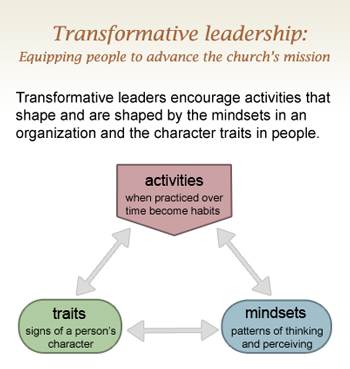
Throughout the process, Moses had to exhibit the trait of humility -- to step away from the center and trust and empower the judges. (That he was successful in doing so is noted by the narrator’s affirmation of Moses’ humility in Numbers 12:3). Thus, everybody had to practice new activities that, with enough repetition, became habits. Those habits, then, enabled a new mindset to permeate the community and instill in its people new traits of character.
Today’s Christian institutions can learn a lot from Moses about what it means to be a transformative leader. He was willing to examine his mindset and work in new ways as the context changed. Mindsets are the default patterns of thinking we use to interpret the world, frame situations, contextualize relationships and respond to leadership challenges. These mindsets emerge from our experiences, but they also are shaped by the activities in which we engage, which establish our habits. A mindset that works well for us at one point in our lives may serve us poorly in another.
This principle is what made Jethro’s advice in Exodus 18 so timely. Moses was willing to listen and risk engaging in new activities because he recognized that fundamentally his leadership was focused on God, not on himself. Moses -- and other leaders facing new circumstances or changed contexts -- can change their mindsets only if they engage in new activities that help them develop new habits.
Consider, for example, a budding social entrepreneur who was her high school and college valedictorian and has a mindset shaped by continuous success. One of the lessons of starting a new organization is having a mindset of experimentation and “survivable failure.” This social entrepreneur will need to engage in activities that enable her to cultivate habits so she learns a new mindset that is otherwise unfamiliar and, initially at least, likely to be destabilizing.
Another example: In late 2008, many Christian organizations faced daunting economic challenges because of the stock market implosion. The mindset of many leaders became dominated by fear and crisis. In April 2009, James Surowiecki wrote in The New Yorker that in such times business leaders tend to be far more worried about “sinking the boat” -- destroying the company by making a bad bet -- than about “missing the boat” -- letting a great opportunity pass.
While a leader with a “crisis” mindset would be inclined to cut the budget and wait for better times, a leader willing to learn a new pattern of thinking might engage in new activities -- remembering the organization’s past, inquiring about current needs, strategizing about the organization’s contribution, experimenting with new services -- leading to new habits and a new mindset of “seeing opportunity.”
Mindsets and activities require and reinforce each other, as do activities and traits. Mindsets are much easier to shape than are traits, which are signs of a person’s character. The Christian life is a journey of learning the ways of God in Christ. Scriptures and the Christian tradition have developed many and varied lists of virtues and characters traits, including the fruit of the Spirit in Galatians 5, as well as the classic cardinal and theological virtues.
Twenty-first-century Christian leaders would do well to consider the character traits that are essential to the habits they are seeking to develop in their organizations. The change in Moses’ practice, for example, both required and reinforced the trait of humility, which enabled him to be receptive to Jethro’s recommendation.
Many leaders think about change as an announcement. Having a clear, compelling picture of the future that can be framed succinctly is important. As James Dubik, the U.S. Army general who directed the transformation of the Army in the 2000s, once told me, “Change is very practical: ‘What do you want me to do differently?’” A vision has to be translated into a set of activities that become habits.
Paul points to this same truth in his letter to the Romans: “Do not be conformed to this world, but be transformed by the renewing of your minds, so that you may discern what is the will of God” (Romans 12:2 NRSV).
Our minds are renewed by focusing on the things of God. The habits of worship, prayer, Bible study and service are what Christians do. Our activities are part of the renewal of our minds, and these activities form us.
Ultimately, we are all about joining with God’s transformative work in the world. God has given a clear vision of his reign. It is for us to translate that vision into the activities, mindsets and traits needed where we live.
Teaching Tools
How would you name the key activities of your organization?
The critical mindsets? The essential character traits? Leadership Education at Duke Divinity suggests these lists as a starting place.
Activities: IRONIES
Integrate
Remember
Observe
Network
Inquire
Experiment
Strategize
Mindsets: CITIES
Cultivation
Imagination
Trust
Improvisation
Excellence
Sustainability
Traits: PITCH
Perseverance
Interpretive charity
Truthfulness
Courage
Humility